Showing posts with label 1980's. Show all posts

Tuesday, January 1, 2013

Distant Voices, Still Lives (1988)


Director: Terence Davies

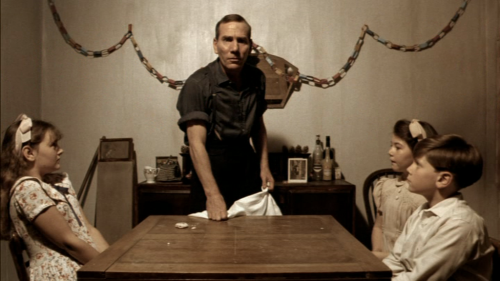
 With a runtime of less than 85 minutes it is astonishing how much this autobiographical work about a British family in the 1940's and 1950's actually accomplishes. It is in essence a portrait of a family (many of the shots are framed like family portraits), and Terence Davies gives us a complete portrait spanning decades in just 85 minutes. It seems like this movie should be a three hour epic, but Davies uses breathtaking efficiency, giving us a kaleidoscopically structured film that emulates the act of memory itself. The temporal structure of the film is hard to make out, but it all comes together in your own mind as a whole and lets you form your judgements yourself. The ephemeral efficiency of the film represents a truly unique masterclass in filmmaking by Davies. He gives us scenes that vary quite a bit when it comes to when they take place (in the first half at least), that tell us all we need to know about how this family of three worked. We learn how their now-dead very strict father's relationship was with each of the three children and their mother, how the children deal with his death, and how they continue on with their own adult lives.

The film really is completely unromantic and quite literally colorless. The colors are all dark, drab, and quite boring, representing a fairly mundane lifestyle that is only slightly cheered up by some group singing, usually in a pub. The music in the film is as important as any other aspect. Important music can live long in our memories, and so in the film the music tells us much about the character and how they lived their lives. For the characters themselves music is shown as a respite from all the bitterness and hardship that exists in Davies' depiction of post-war Britain. This is not a lavish Britain in which elegance pours over, this is a working class Britain hurt and ravaged by the memories of a war that came to their own doorsteps. Davies showcases this family, inspired by his own, as one of the many working class families of that time period that underwent what many families go through: pain, heartbreak, death, love, happiness, and regret. This impressionistic portrait of a family succeeds in such powerful fashion in showing what it really means to be a family, and how those complicated feelings we have towards our sometimes unreasonable family members always seem to inevitably come back to love.

Grade: A

Wednesday, October 3, 2012

Broadcast News (1987)


Director: James L. Brooks

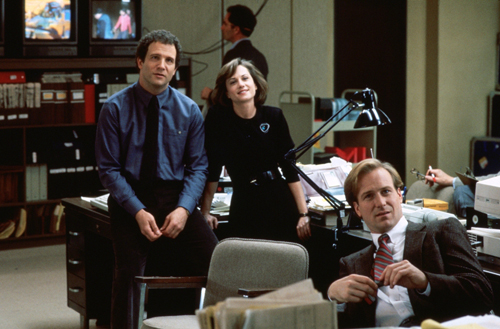
 If you describe a movie to me as being a Hollywood workplace romantic comedy with a love triangle, I probably won't go in expecting to love it. Mostly because it's just a tired formula that Hollywood has done over and over again only because it's a consistent moneymaker and not because there's any artistic merit left in the genre. That's why I was enormously surprised at how much I loved James L. Brooks Broadcast News (also because Brooks himself doesn't have the greatest track record). In this film the workplace is a broadcast news station, but it's more about the people who work in the news than the news itself. But that's why it works. The people provide the emotion, and you get very quickly attached to the characters. There is subtle commentary on the "showbizification" of broadcast news, but the brilliant thing is that it's never broadcasted (pun intended), and instead it's all subtle and fully at the service of the characters.

The three main characters (each played brilliantly by Holly Hunter, Albert Brooks, and William Hurt) are perfectly realized. They each stand for something bigger than themselves, but are still real individuals. Hunter plays a working woman who is successful in her professional life, but struggling in her personal life (think Liz Lemon). As we go through the movie both strands of her professional and personal life are connected together, and at the end of the movie the ethics and principles of her career are actually brought full circle into the romantic conflict in her personal life. It's truly brilliant writing that captures both ideas and emotion. Even though the film is a Hollywood romantic comedy, it still finds a way to be unconventional. You'll find a happy ending in the movie in which things work out to a degree, but it's not the traditional happy ending you would expect. The film makes the statement that while things may not go your way the way you want them to, they will still end up going your way.

Grade: A-

Friday, June 15, 2012

Stardust Memories (1980)


Director: Woody Allen

 The thing that has set apart Woody Allen from everyone else, in my mind at least, is his ability to take complex themes and ideas from filmmakers like Ingmar Bergman and Federico Fellini, and apply them in an American context that is not pretentious or dumbed down. This film is one of the great examples of this. Stardust Memories is one of Allen's most personal films, and is autobiographical in the way 8 1/2 was autobiographical for Fellini. Though at first it may seem like a parody of 8 1/2, it actually is more inspired by it and translates it through Allen's own personal behaviors and issues.

The movie is almost free-associative in structure so it's not the most plot-heavy film, but it's not a hinderance and actually helps in understanding Allen's character and his idiosyncratic personality. The movie is essentially an all-encompassing work about Allen as a filmmaker and Allen as a man, and all of that filtered through his never-ending and always failed search for happiness in an absurd world. It is a very honest, personal, and revealing film, as you would expect from Allen, but this one seems more directly associated with Allen the real man, instead of a character played by Allen. So far, this is one of my favorite Allen films, all because it's such an odd yet personal piece of work by and about a guy that is fascinating in how he embodies the pessimistic yet joyful outlook at life we all have.

Grade: A-

Friday, May 25, 2012

Jean de Florette/Manon of the Spring (1986)


Director: Claude Berri

 I'm writing about these two movies as one because they're basically one four hour long movie. They were intended as one and only split because they would be quite long to watch at once for most people. Both films would be fairly flawed if experienced individually. But as a whole they are an engaging viewing experience that serves as a morality play of unintended consequences. The film has a sold narrative, identifiable characters, and easy messages. The movie is a period pieces based on a book, so it's basically equivalent to the awards-bait type movies we see here in the United States, but that does not mean its bad.

The long running time allows for the film to breath and the pacing is smooth and easy. The movie is relaxed, but never too slow. The payoffs of the film though are not all that surprising or emotional which they're supposed to be. The story is predictable so the payoffs aren't too effective on an emotional standpoint, but the messages of those payoffs are definitely felt, though they aren't completely unique. In the end the film is one of those period pieces that would have won all the Oscars if it were made in America, so depending on how you feel about those kind of movies, this may or may not be for you.

Grade: B

Tuesday, May 22, 2012

Man Facing Southeast (1986)


Director: Eliseo Subiela

 This film is most famous for being ripped off by the American film K-PAX. It features the same plot: a man suddenly appears in a mental institution saying he is from another planet, a doctor then investigates this man and tries to figure out who he is and what he is. That plot synopsis is as science fiction as the movie gets, which is a good thing. The plot could easily have been used for a cliche sci-fi story, but instead the movie is ambiguous enough with its plot that the allegorical aspects come across clearly and very well.

The film is from Argentina, a heavily Catholic country, and the movie really hits at the Christ-like status of the mystery man. His sway over the rest of the patients, his all-around charm, and the way the hospital administrators refuse to believe his story all contribute to his Christ-like nature. The film never brings up religion though, and all of the parallels are subtext, and the movie is all the more better for it. The film parallels faith and mental illness. It's ambiguous enough to the point that those who are religious will find a message that criticizes modern culture for losing faith and showing how Jesus would be shut down if he appeared today, while non-believers will find evidence that supports their beliefs that those who believe they can talk to God are just plain crazy. The plot is certainly not astounding, and there are some odd technical aspects (like the music), but it is still a thought-provoking and well-done film.

Grade: B

Monday, May 21, 2012

The Big Blue (1988)


Director: Luc Besson

 This film is epic, sprawling, meditative, and tranquil. So normally I would love a film like this, but unfortunately, Luc Besson just does not have complete control over his epic narrative and it stumbles frequently. It is not a focused movie thematically or narratively. It tries to be a movie about a man who has a loving obsession with the sea, and a movie about a lifelong rivalry between two great swimmers all at the same time, and there's also something about dolphins.

Much of the film is touching and quite interesting, especially when the movie focuses on the swimmer who is obsessed with the sea and how that obsession makes him a very unsociable human being. That situation makes the romantic subplot of the film quite unique. But the film loses focus eventually. I still greatly admire The Big Blue because what it does right it does very right, but it is not a movie I can say I am a fan of due to its inconsistency. But I will never discourage any filmmaker from trying to make a movie that is this epic and tries this hard. Next time, try a bit harder.

Grade: C+


Saturday, May 19, 2012

The Last Temptation of Christ (1988)


Director: Martin Scorsese

 When looking at a film like this, it is important to take it as a piece of art, and not a historical document. For this movie this is especially necessary because a title card in the beginning explicitly says that this movie is not meant to be a historical document or an adaptation of the story of Jesus from the Bible. If it's not a Christian story of Jesus, then what is it? The Last Temptation of Christ is a film about the eternal spiritual struggle between the desires of the material world and the demands of the divine moralistic world. It uses Jesus by showing that even the most famous religious figure in the world struggled with the sacrifices one must make to fully commit to God.

I don't think I've seen many better films about spirituality than this one here. That is why it is a bit ironic that it got so much controversy from fundamentalist Christians. I'm sure that if they watched the film honestly (if they watched the film at all) they would also relate to the spiritual struggle depicted in the film. Martin Scorsese has said that if he wasn't a filmmaker he probably would have been either a gangster or a priest, because that's the type of culture he grew up in. He's known more for his movies about gangsters, but with this film he shows that he's equally skilled at making films about religion as well.

Grade: A

Monday, April 30, 2012

The Seventh Continent (1989)


Director: Michael Haneke

 Based on a real event in which a family inexplicably kill themselves after destroying all their possessions, Michael Haneke's brilliant debut feature film can be hard to watch, but that's only because the movie wants the audience to have a hard time. The first two thirds of the film are composed of two days in the life of this family, both days separated by a year. They are a bit boring at first, but in retrospect you realize that it is exactly the mundanity of these two days that is so important to what happens on the third day, in which everything unravels.

There is no direct given reason as to why everything unravels and this family does what they do. Instead we see it as a general symptom of their alienating and pointless daily lives. Haneke shows us this by intense close ups of everyday items, forcing us to actually notice the things we do not usually notice. Haneke is such a visceral and powerful filmmaker, he is definitely a provocateur, but he never uses gimmicks. He is not a filmmaker who is afraid to go after the audience and be immensely critical (See: Funny Games). With The Seventh Continent we see that Haneke always had this quality, and he has yet to lose it.

Grade: A-

Thursday, April 12, 2012

Damnation (1988)


Director: Bela Tarr

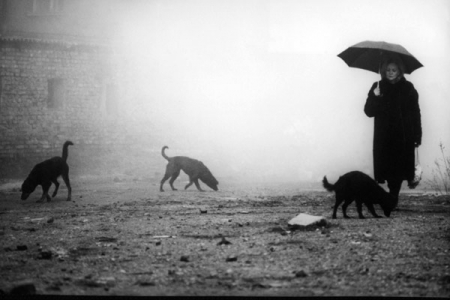
 Set in a black-and-white world that is so bleak and depressing that it almost seems post-apocalyptic, this movie can be difficult to watch. The characters in the movie all have no aim in life and are completely dissatisfied, and the depressed nature of humans is reflected in the visuals and the production design. This is not a movie someone can watch at any moment in time, this is definitely a film you must be in the mood for. It is incredibly well made, the formalist style reflects the films themes greatly, but those themes do not seem to be all that engaging.

But Tarr's style is phenomenal, and the way the gloom and doom of the characters comes across is sometimes brilliant. Animals, rain, garbage, and broken buildings are all used to capture the pointless beast-like existence survival of the human characters, and Tarr's slow camerawork and black-and-white imagery all feels appropriately dark and bleak. I may not have gotten everything I could have gotten out of this film in one viewing, because there are philosophical ideas buried deep within the film, especially through the indirect and sometimes difficult to decipher dialogue. But that promise of something deeper about the human condition will definitely bring me back.

Grade: B

Thursday, March 22, 2012

Breathless (1983)


Director: Jim McBride

This is a remake of the landmark French film by Jean-Luc Godard of the same title, so expectations were quite low coming into this one. But to my surprise it was not horrible, it actually is an interesting translation of the French original to an American context. It captures much of the depth of the love story in the original and does includes its own pop cultural references like Silver Surfer and Jerry Lee Lewis. Richard Gere's performance is also quite good, though I cannot say the same for the female lead, who is frankly horrible.

It's in no way a great movie, and there are some laughable moments that are the epitome of 1980's cheese, but by the end this relationship at the center of the movie becomes fairly real and the love between the two characters feels as complicated as it should. It's not a subtle film in the slightest, everything about it is direct, and unlike the original there is nothing all that experimental or rebellious in the filmmaking to reflect the main character. While it's not the most wonderful film, it is one that takes you by surprise in its intertextuality and its genuine emotion.

Grade: B-

Saturday, December 10, 2011

Filmcap: The week of Oct 16-23


Vagabond, The Constant Gardener, and The Messenger are some of the movies reviewed this week. There's also a little bit of a World War II theme with Resnais' Night and Fog and Truffaut's The Last Metro, both French films coincidentally. In this post you can also find some words about how people view free spirited people, how we can avoid another Holocaust, and the different ways we all grieve. 

Friday, December 2, 2011

Filmcap: The week of Oct 9-16


Rumble Fish, Germany Year Zero, and the epic fourth season of Breaking Bad. Only three things this week, but they're all very top notch. Only one week after the long Deadwood Season three post, I come back with an even longer post that is almost as long The Tree of Life post, but still not quite. The review of Breaking Bad has no detailed spoilers at all, and there are some statements about the trajectory of the show, nothing should be that bad. If you want to be completely pure of any and all spoilers, like some of the complex characteristics of Walt, then you may want to stay away. Otherwise I hope it will convince most of you to watch the show. For those who have seen the show, I point you towards the last paragraph for my thoughts on what the show is about on a macro level. 

Tuesday, November 22, 2011

Filmcap: The week of Oct 2-9


Bunuel's The Discreet Charm of the Bourgeoisie, von Trier's Europa, and the final season of Deadwood all feature in this post. Yes it's been a long while since my last one, and I am good awfully behind, but I am determined to keep it going. Quite a large variety of stuff in this one. It includes a couple of television documentaries about history and also the culmination of a series that almost serves as the history of society. The Deadwood post is possibly the longest in this blogs history, maybe being second only to The Tree of Life post. 

Tuesday, September 27, 2011

Filmcap: The week of Sept 4-11


Fish Tank, Grand Illusion, Funny Games, and recently completed season of Louie are highlights from this abnormally great and lengthy week. Minimal amount of schoolwork, a realization that this is my last year of school and thus last chance to really go all out with my movie watching, and also the ending of two television show seasons all culminated in a lot of entries for this week. In this post you'll find discussions on how the differences between a great miserabilist film and a bad one, the benefits of personal filmmaking, and the lack of intellectual provocation in the movies. 

Sunday, August 21, 2011

Filmcap: The week of July 3-10


This week I discuss the weakest Almodovar film I've seen yet but still comment on how good he is, and I also compare apply the lessons of a Kubrick classic to the recent London riots. 


Thursday, April 21, 2011

Filmcap: The week of April 10-17


This week I review a recent HBO miniseries, a quirky but great movie, two thrillers from different eras, one character study, and another Iranian film in my continuing research for a paper on Iranian cinema I'm going to write soon for my Art & Society class.


Friday, April 1, 2011

Filmcap: the week of Mar 20-27


In this post I've got a couple superb realist post-crisis foreign films, one from post-war Italy, and another is post-revolution Iran. A couple recent films, one brand new and horrible, the other from last year and amazing. Then there's a little-talked about film from a great director, and a much-talked about genre film I have finally watched. Also, links to two very good short films.


Monday, February 7, 2011

Filmcap: The week of Jan 30-Feb 6


This week somehow happened to a pretty good movie watching week with four legitimately great films, one Polish, one British set in Australia, one French in English, and one French and Austrian in French. The two not as great movies were (coincidentally?) both American and both big Academy Awards winners, though admittedly one of which, as you'll see below, was actually pretty good. Read all about it.

Monday, January 17, 2011

Filmcap: The week of Jan 9-16


In this week's second ever installment of Fimcap I write about a movie with an amazing poster, the single best sports movie of all time, two early John Wayne-starring acclaimed westerns, and one of the independent movies that started all independent movies.