Showing posts with label Belgium. Show all posts

Friday, January 4, 2013

Rosetta (1999)


Directors: Jean-Pierre and Luc Dardenne

 It is a rare and impressive thing when a filmmaker can craft an intimate and personal film while also bringing with it such broad social and political implications. The film is an uncompromising look at a 17-year-old girl who lives in a small trailer with her good-for-nothing mother trying to find a job. She's a girl who is desperate for any sort of job, but she's also a principled human being who just wants to have a normal life. Her desire for a job has to do with money, but it's also about being a normal member of society, and that's what gives this film added poignancy. The Dardenne brothers use their typical handheld jittery up-close camerawork, always following our main character, and frequently in tight close-ups. It gives this deeply personal look at a life in motion even more intimacy, but at the same time it manages to also be about the larger issue of the difficulty that those on the fringes of society have in entering into society.

One of the reasons I will cherish and remember this film for a long time is because it's not an idealistic film like so many others are, it's not a contrarian movie about the ills of society. The film does not take a stance against the idea of modern society, instead it just says that society needs to do more to help those who want to enter modern society. It's a very pragmatic movie and not one with high-minded ideas, and that's a very unique stand to take in intellectual art. Rosetta is essentially a film about the lack of social mobility, and the difficulties people have in obtaining an honest living. It's telling that Rosetta refuses to do any illegal jobs in this film, because she is a person with respect and principles, a quality very deserving of entering society. She does have to engage in a personal betrayal later in the film though, which is not illegal, but certainly only hurts her social life. That betrayal shines a light on the how obtaining even honest work can be a very anti-personal endeavor, because in this economic system personal relationships must be second to money and success. What's more amazing is that none of these messages are said out loud, everything is implied. It's a movie that shows you the life of one person on the fringes of society and forces you to make your own conclusions about why this girl is having so much difficulty. It manages to be political by way of being personal.

Grade: A

Saturday, April 21, 2012

The Artist (2011)


Director: Michel Hazanavicius

 I reviewed this film for the newspaper. You can find that review here.

I don't have much more to add except to say that I really enjoyed the movie for what it is and I respect it for being so successful despite the obvious setbacks. There were better movies in 2011, but I don't expect the Best Picture winner to ever be my personal favorite film, because I'm not the one voting. So I will never complain when it goes to a good movie that I respect. Maybe it doesn't make audiences think too much, but it does make them think outside the box when it comes to silent movies, black-and-white movies, and old movies.

Grade: B

Saturday, March 3, 2012

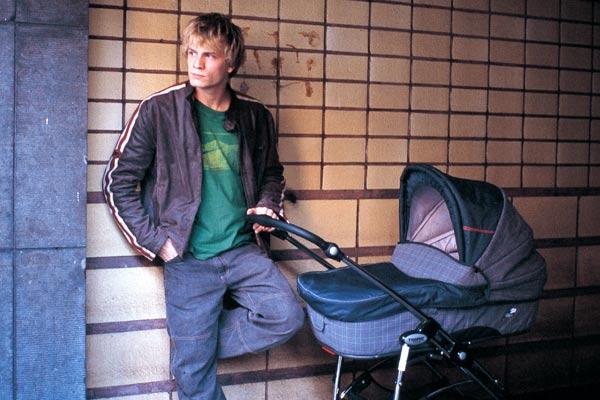
L'Enfant (2005)


Directors: Jean-Pierre and Luc Dardenne

Modern culture has celebrated and encouraged arrested adolescence. This mantra of leaving adulthood till as later as possible. In this Dardenne brothers movie, the other side of that notion is shown. What happens when that type of person first encounters adult responsibilities. Our main character, Bruno, finds himself living in a part of town that is lacking in jobs, and so he usually spends his time doing petty crime trying to make some money. But he then has a child with his girlfriend, and while his girlfriend is similar to him, she seems to have a better sense of responsibility than him now that she's had a child.

The story is a coming-of-age tale for Bruno, but one that is more effective than most because Bruno actually faces real lasting consequences for his rash decisions. Purely as a descriptive term, the movie is bit like Truffaut's The 400 Blows meets Godard's Breathless. Bruno is similar to Michel in Breathless, but what happens to Bruno, and the tone of the movie, is more similar to The 400 Blows. The Dardenne's trademark documentary-like observational approach is used once again very effectively to help give the movie a completely natural feel. It is also important they capture the working-class milieu of Bruno's environment, because that gives us subtle hints as to why it may not be completely his fault as to why he is stuck in this arrested development.

Grade: A-

Wednesday, March 9, 2011

Filmcap: The week of Feb 27-Mar 6


A lot of movies this week that also broke the two week absence of no A/A- movies but also includes some well deserved B+'s. Coming up we've got two film noirs, two intimate European dramas, two surprisingly similar "black" movies, and one 2011 movie.