Showing posts with label Grade A movies. Show all posts

Wednesday, January 23, 2013

Holy Motors (2012)


Director: Leos Carax

 It is not too difficult to appreciate this film, or to admire this film, or to enjoy this film, but understanding what it all means it is a different story. There is a lot going, and deciphering every single thing about this film may prove impossible on a first viewing. But when looking at the film overall, it's quite simple. We see an actor do rides around a limousine over the course of a single day doing nine different "appointments". He acts as an old lady begging in the street, he performs on a motion capture stage, he plays a father picking up his daughter from a party, he plays a sewer creature who kidnaps a model, he plays an old man on the verge of death, etc. The odd thing about these "appointments" is that there are no cameras or audience around, at least not visibly. He is performing these acts in the real world. The film hints that digital cameras are so small now, that they are invisible.

The film is a remarkably unique film in that every one of the "acts" Denis Lavant's character performs performs are executed to perfection. While the film does make sense as a whole, it's certain that director Leos Carax also wanted the opportunity to tackle all sorts of genres in one movie (it's his first film in 13 years, so he has a lot of catching up to do). He tackles these familiar genres because these genres are the "typical" entertainment we have in our lives, and because we are always performing for the omniscient camera, these genres become our reality. The digitalization of not just cinema, but of everything in our culture, has made it so in our constant performance for the camera we have lost our sense of identity. Our identity has slipped away behind the veneer of technology and the ways we choose to portray ourselves to the world. With its unique ambiguous structure, Holy Motors shows that truth in identity is slipping away from all of us in our increasingly technology-dependent world. Through it's multiple "episodes" Holy Motors is a mystifying, powerful, sensational, and thought-provoking film that tells us much about who we are and where we're going.

Grade: A

Friday, January 4, 2013

Rosetta (1999)


Directors: Jean-Pierre and Luc Dardenne

 It is a rare and impressive thing when a filmmaker can craft an intimate and personal film while also bringing with it such broad social and political implications. The film is an uncompromising look at a 17-year-old girl who lives in a small trailer with her good-for-nothing mother trying to find a job. She's a girl who is desperate for any sort of job, but she's also a principled human being who just wants to have a normal life. Her desire for a job has to do with money, but it's also about being a normal member of society, and that's what gives this film added poignancy. The Dardenne brothers use their typical handheld jittery up-close camerawork, always following our main character, and frequently in tight close-ups. It gives this deeply personal look at a life in motion even more intimacy, but at the same time it manages to also be about the larger issue of the difficulty that those on the fringes of society have in entering into society.

One of the reasons I will cherish and remember this film for a long time is because it's not an idealistic film like so many others are, it's not a contrarian movie about the ills of society. The film does not take a stance against the idea of modern society, instead it just says that society needs to do more to help those who want to enter modern society. It's a very pragmatic movie and not one with high-minded ideas, and that's a very unique stand to take in intellectual art. Rosetta is essentially a film about the lack of social mobility, and the difficulties people have in obtaining an honest living. It's telling that Rosetta refuses to do any illegal jobs in this film, because she is a person with respect and principles, a quality very deserving of entering society. She does have to engage in a personal betrayal later in the film though, which is not illegal, but certainly only hurts her social life. That betrayal shines a light on the how obtaining even honest work can be a very anti-personal endeavor, because in this economic system personal relationships must be second to money and success. What's more amazing is that none of these messages are said out loud, everything is implied. It's a movie that shows you the life of one person on the fringes of society and forces you to make your own conclusions about why this girl is having so much difficulty. It manages to be political by way of being personal.

Grade: A

Tuesday, January 1, 2013

Distant Voices, Still Lives (1988)


Director: Terence Davies

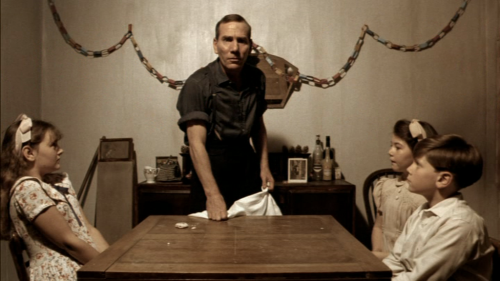
 With a runtime of less than 85 minutes it is astonishing how much this autobiographical work about a British family in the 1940's and 1950's actually accomplishes. It is in essence a portrait of a family (many of the shots are framed like family portraits), and Terence Davies gives us a complete portrait spanning decades in just 85 minutes. It seems like this movie should be a three hour epic, but Davies uses breathtaking efficiency, giving us a kaleidoscopically structured film that emulates the act of memory itself. The temporal structure of the film is hard to make out, but it all comes together in your own mind as a whole and lets you form your judgements yourself. The ephemeral efficiency of the film represents a truly unique masterclass in filmmaking by Davies. He gives us scenes that vary quite a bit when it comes to when they take place (in the first half at least), that tell us all we need to know about how this family of three worked. We learn how their now-dead very strict father's relationship was with each of the three children and their mother, how the children deal with his death, and how they continue on with their own adult lives.

The film really is completely unromantic and quite literally colorless. The colors are all dark, drab, and quite boring, representing a fairly mundane lifestyle that is only slightly cheered up by some group singing, usually in a pub. The music in the film is as important as any other aspect. Important music can live long in our memories, and so in the film the music tells us much about the character and how they lived their lives. For the characters themselves music is shown as a respite from all the bitterness and hardship that exists in Davies' depiction of post-war Britain. This is not a lavish Britain in which elegance pours over, this is a working class Britain hurt and ravaged by the memories of a war that came to their own doorsteps. Davies showcases this family, inspired by his own, as one of the many working class families of that time period that underwent what many families go through: pain, heartbreak, death, love, happiness, and regret. This impressionistic portrait of a family succeeds in such powerful fashion in showing what it really means to be a family, and how those complicated feelings we have towards our sometimes unreasonable family members always seem to inevitably come back to love.

Grade: A

Monday, December 10, 2012

La Jetee (1962)


Director: Chris Marker

 The opening credits of this short film bill it as a "photo-novel". A fairly accurate description, as the 28-minute film is pretty much completely made of nothing but black-and-white still images. It sounds like it's mostly an experiment in form and that the still image format is just some experimental gimmick, but this film actually works brilliantly on every level. The still images bring cinema back to its roots. Cinema is basically a bunch of photos shown in quick successive motion (24 frames a second usually), so this film just does it all in much much slower motion and proves that it is the illusion of movement that creates the illusion of linearity that makes film so powerful as a format. Director Chris Marker then equates that with how our memory works, which directly ties into the subject matter of the film, which is time travel.

The main character of the film has a strong memory, an image of a woman he once saw before the world had been destroyed and everyone moved underground, and the strength of that image gives him the mental stamina that allows him to be the perfect guinea pig for a time travel experiment (this film was the inspiration for Terry Gilliam's 12 Monkeys). The movie gives us the poignant notion that memory is basically a form of time travel, that memory is a way for us to back in time while time is really moving forward. It's the perfect story for a film made with still images. Photographs are memories, and for the main character the memory in his head was so powerful that it enabled him to go back in time, just like how movies (photographs in quick motion) can be so powerful that they can enable us to feel like we're going back in time. It's amazing how visceral a movie that has no motion can feel. La Jetee is maybe the most intellectual film about time travel I've ever seen, Marker uses time travel not as a gimmicky plot conceit, but a way to look at the human minds relationship to the world around it. It's an amazing accomplishment that a 28-minute black-and-white film with nothing but still images can be simultaneously about the nature of memory, the nature of time, and the nature of cinema itself.

Grade: A

Wednesday, November 14, 2012

The Master (2012)


Director: Paul Thomas Anderson

 Elusive. Challenging. Mysterious. These are just some of the words that critics and audiences used in describing The Master. Paul Thomas Anderson certainly did not intend on making an easy film in which the meaning is preached to the audience. Instead, the audience must extrapolate the meaning, but what makes it even more difficult is that it would be perfectly legitimate for five different viewers of the film to have five different interpretations of what the film means. I'm sure it's a film that will see its various interpretations dwindle as more people see it more times, because this is a film that slowly reveals itself as you watch, and reveals itself more on repeat viewings (I've seen it twice). At first we notice Joaquin Phoenix's outstanding performance as Freddie Quell, a man who is the epitome of social outcast. But then we start to see his relationship to Lancaster Dodd, the leader of a newly launched cult, and the many complexities involved in the relationship between the two men. Then later it occurs us to the broader social implications the film has on topics as broad as post-war America and cults.

The way I see it, and I think that's the only legitimate way I can start a conversation about this film, is that that this is a film about the complex relationship between a master and his followers. In the film, Dodd sees Quell as a wild savage dog, and he sees it as his duty as the civilized master to tame this seemingly untamable dog. Why Dodd decides to take this challenge up is because he sees his past in him, and he sees a successful taming of Quell as vindication of his own self and his own efforts. But the film is not so simple as to show Dodd as simply a noble master and Quell as dastardly savage dog. The lines between the two are blurred. The performances of both Hoffman as Dodd and Phoenix as Quell couldn't be more different, one is Wellesian in it's grandeur and control, while the other is unpredictable and wild. They are two extremes of masculinity, but we still see that Dodd is not the saint he thinks he is and Quell is not simply a barbaric wild dog. Dodd has outbursts and desires that Quell has, while Quell shows small moments of compassion and empathy. The Master questions the follower-leader relationship, but it's not specifically for or against the notion that everyone needs a master, instead it shows us how complex that relationship truly is. Yes the film feels elusive when you first watch it, but it's a film that comes closer and closer to you the more you take it in.

Grade: A


Saturday, October 20, 2012

McCabe & Mrs. Miller (1971)


Director: Robert Altman

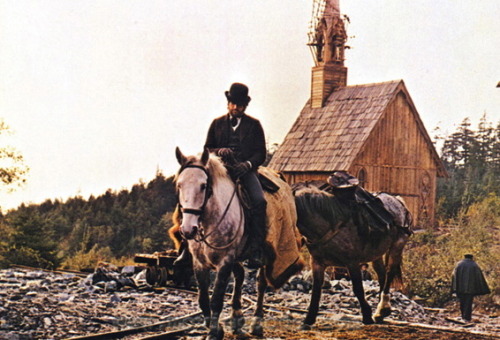
If this film is a deconstruction of the western genre, then this might be the best genre deconstruction ever committed to film. It subverts many traditional notions of the genre, but more impressively, it's a film that feels like a unique and great film on its own, irrespective of the statements it might be making on the western genre. It definitely subverts the myths of the western on purpose, most significantly with the lead character McCabe who initially comes into this Pacific Northwest town looking like a legendary gunslinger, but is slowly unwrapped and revealed as a man who is less a mythical figure than just a real human being. In keeping with the subversion of gender tropes in the western genre, Mrs. Miller, the madame of a group of prostitutes, comes across as quite business savvy, much more so than McCabe who seems to be taking advice from her on how to run his brothel. In this film it is the woman who influences the man.

Altman also uses the rain, the gray skies, green trees, and the fog of the Pacific Northwest setting as a way to make the film feel a bit off. It creates a naturalistic atmosphere for the film while also giving us something much more unique than the typical blue skies and endless barren flat landscapes of most westerns. That natural, and even ethereal, tone of the film is one of the most impressive elements of the film. Altman lets his setting breath, his actors emote naturally, and films everything with an unobtrusive eye. On top of that is the amazing acoustic soundtrack by Leonard Cohen. The importance that soundtrack has to the melancholic feel of the characters cannot be understated. McCabe's melancholic feelings are what truly make the movie for me. His character is such a thoughtful and subtle attack on our concept of masculinity, and his private soliloquy's to himself, especially regarding his feelings towards Mrs. Miller, provide some of the greatest moments of the film. The film does so much (there's even vilification of the no holds-barred free enterprise system) while feeling completely natural. McCabe & Mrs. Miller is a naturalist film all the way, and that's why it's amazing it does so much while doing so little.

Grade: A

Tuesday, June 26, 2012

Malcolm X (1992)


Director: Spike Lee

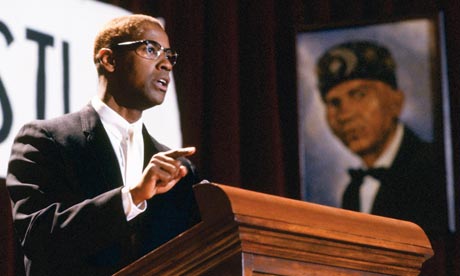
 It's really a compliment to the film Spike Lee made that after watching the movie I had nothing to say about the film itself, and everything to say about Malcolm X. The autobiography that this film is based on is easily one of the best books I have read in my life, and just by virtue of adapting for the screen and actually keeping the essence of the book intact makes this film one of the finest and most flawless biopics of all time. Almost all biopics try to find one thing that defined the life of their subject, but this is impossible to do with Malcolm X because he is a man defined by his progression in life. His views evolved all throughout his life, and were continuing to do so even until he was assassinated.

Lee knows this, and follows him from all throughout his life, giving equal weight to each portion, from the beginning when he was Malcolm Little, to his criminal days when he was Detroit Red, to when he was with the NOI as Minister Malcolm X, till the end when he was El-Hajj Malik El-Shabazz. A filmmaker could easily make a movie about Malcolm X and give a completely inaccurate depiction of the man by just focusing on a certain portion of his life, but Lee gives us the whole picture, and this way we get an honest, truthful, and powerful progression. It is a long movie, running about three and a half hours, but I never thought it was boring and never found any scene unnecessary. Because of Denzel Washington's career-making performance as the man himself, and Lee's real knowledge and respect for the man, we surprisingly have a completely honest film about Malcolm X, one that will hopefully show the world the mans true impact on our world.

Grade: A

Saturday, June 16, 2012

Crimson Gold (2003)


Director: Jafar Panahi

 This film is Iran's Taxi Driver. Or maybe it is Iran's The Wire. Who knows, I just wanted to start this off with a hyperbolic generalized statement to get your attention, and now I have it. The point is that Taxi Driver is one of my favorite films of all time, and The Wire is one of my favorite television shows of all time and so I don't compare to them lightly. But I won't compare them, because this is because this film is a masterpiece in its own right. It is a movie that reveals the motives of those "second-class" citizens who are quietly fuming at the world. The lead character in this film is so tired of being treated like he is not as important as other humans who have more money. But in the film he is not asking to be rich, he is just asking for respect, and his anger represents so many around the world.

His realization over the course of the movie of how tragically static his situation really is shows how society as a whole, and not just in Iran, can be unfair to those who may not have the money necessary to have their voice heard. There is much dread in the film, because we know from the opening flash-forward in which he is involved in a robbery gone wrong that this will be a tragic story. But that dread adds poetry and meaning to the rest of the film. The lead performance is one that is very subdued, all of his feelings are deep inside and he never ever shows them. His anger is slowly boiling to the top, but we only know this because we know his sad final actions. Crimson Gold is quiet and angry at the same time. Written by the great Abbas Kiarostami, the screenplay has the subtle characterizations that he is known for, always keeping the audience just enough at bay. Director Jafar Panahi adds his trademark social critique and sense of social justice. Both of them team up to make a film that has a flawless sense of character, justice, class, and emotion.

Grade: A


Saturday, May 19, 2012

The Last Temptation of Christ (1988)


Director: Martin Scorsese

 When looking at a film like this, it is important to take it as a piece of art, and not a historical document. For this movie this is especially necessary because a title card in the beginning explicitly says that this movie is not meant to be a historical document or an adaptation of the story of Jesus from the Bible. If it's not a Christian story of Jesus, then what is it? The Last Temptation of Christ is a film about the eternal spiritual struggle between the desires of the material world and the demands of the divine moralistic world. It uses Jesus by showing that even the most famous religious figure in the world struggled with the sacrifices one must make to fully commit to God.

I don't think I've seen many better films about spirituality than this one here. That is why it is a bit ironic that it got so much controversy from fundamentalist Christians. I'm sure that if they watched the film honestly (if they watched the film at all) they would also relate to the spiritual struggle depicted in the film. Martin Scorsese has said that if he wasn't a filmmaker he probably would have been either a gangster or a priest, because that's the type of culture he grew up in. He's known more for his movies about gangsters, but with this film he shows that he's equally skilled at making films about religion as well.

Grade: A

Monday, April 30, 2012

Harlan County, U.S.A. (1976)


Director: Barbara Kopple

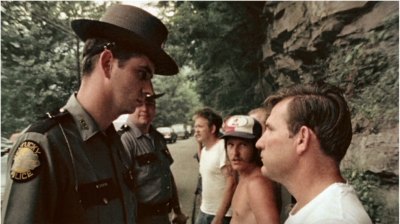
 This is a classic documentary about organizing coal miners that so simply and effectively takes on the cause of the working class against the corporations. The union is the one institution that has the potential to actually fight corporations and win, and this great movie displays how hard the corporations will push back against organizing workers. The movie displays the tactics that the corporation will use in order to put down the unions and to please their shareholders, it reminds me of governments who will do anything to put down uprisings, including using violence.

The film is best at showing the difficulties in the lives of these coal miners and the sacrifices and effort they must go through to get what they need for themselves, which is respect and fairness. Launching a movement against such a powerful company can be very difficult, and more often than not immense sacrifices must be made to get that, sometimes they even include death. We really end up getting to know some of the miners most involved in the situation, and I really enjoyed the very personal songs the film would play that were written and sung by coal miners and their wives. Barbara Kopple took some great risks in making this film, including risks to her physical self, and it really pays off because this is one important documentary.

Grade: A

Monday, April 23, 2012

Playtime (1967)


Director: Jacques Tati

I guess technically this film is a comedy, but I am absolutely positive that there is no other comedy like this one. This is a film that is a satire against the modern urbanization that makes the world an impersonal place filled with blandness and a machine-like lifestyle for everyone. It also displays the illusion so many of us live in, our pre-conceived cultural and societal notions that bar us from seeing the negative effects of urbanization and globalization.

It's a very long movie that is composed of many gags and individual scenes rather than one straightforward plot, but it's the images that do so much of the storytelling. The film was shot in 65mm, and the widescreen compositions are immensely detailed and choreographed. This film uses the visual image better than almost any film I've ever seen. There is hardly a main subject on the screen, rather, everything going on in the frame is important, even in the corner of the screen. There is an extraordinary amount of details filled in one image. Playtime is an absolute masterpiece that I will definitely be seeing again. It is a highly ambitious film with very elaborate sets, and it all plays amazingly well.

Grade: A

Saturday, April 14, 2012

L'Avventura (1960)


Director: Michelangelo Antonioni

 The central mystery in this movie is the disappearance of a woman. But midway through the movie, that mystery is totally abandoned, but in a way, we get to see the type of life that may have motivated the woman to disappear in the first place. It's a movie about the alienation of the rich and privileged. Instead of criticizing the whole elitist culture like so many other films I've reviewed recently have done, this film takes a look at the rich and privileged on a more individual and sympathetic basis.

It doesn't let them off the hook, but it shows the existential crisis that their privileged, but boring, lifestyle brings. The main character, Claudia, is the one who most undergoes an existential crisis, and the brooding and internal crises that she goes through are realized brilliantly by Antonioni. All of her feelings come across due to the patient pacing of the film and especially the meticulously composed shots. This is a movie that uses visuals exactly how they should be used in film, not just as beauty, but as beauty that tells us who the people in photos are.

Grade: A

Friday, April 6, 2012

Contempt (1963)


Director: Jean-Luc Godard

 This film was Godard's first, and only, relatively big budget film with star power. Bridget Bardot stars in the movie, but Godard makes us ultra-aware of not only her star persona, but the big budget nature of the movie. He takes on commercial filmmaking while making a commercial film, and one of the ways he does that is in the opening scene, which plays on Bardot's physical beauty and his producers requests to objectify it. He also parallels his own story with the director of the film-within-the-film played by Fritz Lang (playing himself). The main character is also a screenwriter worried about selling himself out, but needing money.

But the movie still works as a pure emotional experience as well. The break up between the two leads is one that is done thoughtfully and authentically. Almost the whole second act takes place in an apartment where an argument between the couple is taking place, and while that scene is unusually long, it feels completely honest. Both of them have real problems that real people would have, and the way they argue is also completely accurate in the way that they are arguing but do not completely hate each other. Godard proves himself with his ability to capture genuine emotion and issues, but also can comment on commercial filmmaking with his experimental filmmaking techniques. It is a marvel to watch.

Grade: A

Friday, March 23, 2012

The Rules of the Game (1939)


Director: Jean Renoir

 Satires of the upper class have been done in film time and time again, but The Rules of the Game is one of the first, and maybe the most scathing of them all. It is technically a light satire (this film likely influenced Bergman's Smiles of a Summer Night, which I reviewed recently), but that satire is not afraid to be extremely harsh and critical. The film consists of a large number of French bourgeoisie who are in a estate together for a vacation, and in this "vacation" we see how their fake rules force them to do things that are sometimes nonsensical, and sometimes completely inhumane.

Renoir does not criticize them to the point of dehumanizing them though, the humanity of the characters is intact but, like in Renoir's Grand Illusion, the artificial constructs of society are what make these people act so idiotic. Renoir does a masterful job with a story with so many characters and still keeping it coherent and flowing. The film moves seamlessly from scene to scene, from character to character showing everyone and in all their messed up glory. This is all just surface level analysis, because there is so much more underneath that can be taken away from this film with multiple viewings. This is one I will definitely revisit.

Grade: A

Tuesday, February 14, 2012

A Separation (2011)


Director: Asghar Farhadi


It is surprising how many films have their characters painted as exclusively good or exclusively bad. That is why it is so refreshing to see a film like A Separation, one in which all of the characters are complex and can be seen as good and bad simultaneously. The film is an incredibly rich character drama that starts off with a divorce, but one that only unravels further after that and ends up being one of the most morally complex films I have seen in years.


Every character in this film has a moral dilemma that is instigated because of their situation, which includes where they live or how much money they have. Every adult character can potentially grab your sympathies, because even though some of these characters lie, the reasons they do so are spelled out very clearly. The husband and wife at the center of the eponymous separation both struggle with the conflict between compromising principles for practical benefits and standing behind your principles at all costs. It would have been very easy to make one of these characters the bad guy, but Farhadi does an incredible job at making sure everyone has an understandable point. Because the film is so moralistic, it is very likely you will end up sympathizing with one character more because of your own morals, but in that way the movie makes the audience examine their own morals.


As the film goes on though, there are a couple characters that start to come to the forefront as pure characters, and those are the children. Children are innocent and pure, and in these adult conflicts they are always the one who end up being the collateral damage. I have yet to see a film that gets across how it is always the children that lose in divorces. A Separation reveals the many battles human beings have with and within themselves and the real world consequences of those battles.


Grade: A