Showing posts with label Grade B movies. Show all posts

Wednesday, February 6, 2013

Haywire (2012)


Director: Steven Soderbergh

As written this film is basically your average Euro spy thriller. A clandestine spy does jobs in major European cities, one of them goes wrong and there's a bit of mystery as to her employers intention and eventually some revenge comes into play. It's all pretty generic stuff. But in comes Steven Soderbergh, whose filmmaking expertise can do wonders with any story. This film basically is a how-to guide when it comes to shooting action movies. His directing stands out in every scene. The action scenes are filmed with authenticity and are not afraid to show off the stunningly choreographed action set pieces. He does not create the fight scenes in the editing bay like so many other Hollywood action movies do nowadays, he utilizes the set and uses wide shots to make sure every blow feels real.

A big reason as to why the fight scenes feel real and authentic is due to Soderbergh's casting of former MMA fighter Gina Carano as the lead character. She knows how to fight, and Soderbergh lets her strut her skills on camera with no manipulation. On top of her great fight choreography, she serves her character well with her quiet and mysterious performance. While the film is filled with great visuals and refreshing fight scenes, and the film is unabashedly more style than substance, the lack of substance is still what keeps the movie from being a truly great film. It's a masterclass on creating a good genre picture but that means it's still a genre picture with not a whole lot of lasting significance. But at the same time Soderbergh did not try to create a masterpiece. Soderbergh's great blocking, cinematography, editing, pacing, music, and sound once again shows that he is a master of filmmaking craft.

Grade: B

Tuesday, January 15, 2013

Miss Bala (2012)


Director: Gerardo Naranjo

What this movie accomplishes basically makes it an "issue" movie. It's about the consequences of the Mexican Drug War that has taken hundreds of lives and scared thousands more. Issue movies can be tiresome if not done well because no one likes being preached or lectured to. Miss Bala avoids this problem fairly well (but not completely in my opinion) by focusing on one innocent character and her horrific experiences as she is dragged unwillingly into this war. With this it shows us the consequences the drug war has had on the innocent and how it has ruined and affected the lives of so many innocent people. It's not a revolutionary subject but nonetheless an important one and the fact that the film has seen worldwide attention (it played at Cannes 2011) is a wonderful thing.

The main character of the film who is dragged into the war is a woman whose goal is to get into a beauty pageant. It's a bit cliche and contrived to make the main character a good-looking girl who just wants to look good, but I can't blame Naranjo too much because he was apparently influenced by a real-life story in which a beauty pageant contestant was found to be involved with the cartels. It's also a testament to Naranjo's filmmaking that the movie does not feel as cliche as it could have been. He shies away from easy emotions and instead opts for some truly visceral filmmaking in some tense sequences and some beautiful patient long shots that display the despair and hopelessness of the situation. Naranjo captures the predicament of this girl using her own perspective, including showing us her point of view during shootouts, which puts the audience in the exact same situation as her. Even though the main character is a beauty pageant contestant, the film still succeeds in showing that the victims of the cartels are people just like you and me and that's exactly what a film like this wants to do.

Grade: B

The Imposter (2012)


Director: Bart Layton

Coming into this film I had never heard of this story about a man who steals the identity of a missing child, and that I think improved by experience of this film quite a bit. Director Bart Layton takes a fairly  fascinating story about manipulation and manipulates it in his own way resulting in an absolutely wild ride of a documentary filled with twists and turns. Layton controls the audiences reactions in the film very effectively using things like manipulating interviews with subjects and making it seem like the interview subjects know just as much as the audience. It's also no secret that this guy is not actually the missing child this family has been looking for, which creates unbearable tension during early sequences in which the man meets this family. We know this guy is going to be revealed eventually, but we don't know when and we don't know how and that keeps the audience on its toes at all times. And I'm not even going to mention some of the later twists that come out of nowhere.

The Imposter is not just a great sensory experience (the first time you see it at least), but not a bad intellectual one as well. At first the film is an example of the extreme power of confirmation bias, not accepting something that may be against your preconceived beliefs. We see such an extreme form of confirmation bias in that a parent doesn't even recognize her own son. But in the final act of the film things get a little more muddled and unfortunately the movie brings up a point (I won't spoil it) that I thought was astonishing while watching, but in retrospect is the only example of Layton going a little overboard when it comes to manipulating the audience. That brings up the fact that the film is astonishing when you're watching the first time without knowing any of the story, but thinking back about the story (and maybe a second viewing) diminishes the impact just a bit. Ultimately I can't imagine anyone not having an extremely engaging experience with this documentary that asks us all question about truth, lies, assumptions, and manipulations.

Grade: B

Friday, January 11, 2013

Killing Them Softly (2012)


Director: Andrew Dominik

The first thing to know about this film is that this is not really a film meant to entertain you, at least not in the conventional genre sort of way. It's technically a gangster film, but even fans of the gangster genre probably will be surprised (putting it gently) by this film. This is a political film about the Great Recession of 2008. I'm not saying that the subtext of this film is political, because the political elements are right there on the surface. Many critics complained that the movie made the political commentary way too obvious and hits the audience on the head, but I think director Andrew Dominik intended on first and foremost making the film as an allegory for our times, and not just a gangster film with subtle political commentary. But I do admit there may be other, and probably better, ways to do that besides inundating the sound mix with Obama and McCain campaign speeches on the radio or television. At the same time, that inundation is successful in making the audience always have the political edge at the forefront of their mind. This way we can make the connections that so much of the film stands in for different parts of our government and financial system, which is pretty important because the gangster story would not be engaging on its own without any of the political commentary.

The 2008 setting gives the film the right mood for this to happen as well. In the movie we've got criminals who put a hit out on a couple of guys who stole some money, and most of the movie is about the game that has to be played in trying to make sure the right people or the right message is sent out when it comes to punishing the people who stole. It's a smart allegory for the aftermath of the 2008 financial crisis and how difficult it was to punish the Wall Street-types who were responsible for the collapse. The allegory is quite an impressive feat considering that the book Dominik adapted the movie from was written back in the 1970's, way before the 2008 recession. While ultimately the gangster story feels a bit slight and not quite as powerful as it could have been (though the gangster genre sets quite a high standard), Dominik crafts some spectacular scenes, including the creative opening credits, the brilliantly tense stick-up job at the center of the movie, and a great dope-smoking scene. Coming off the amazing The Assassination of Jesse James by the Coward Robert Ford it's hard not to feel that Killing Them Softly is a bit of a step down, but Killing Them Softly is still a fantastic display of Dominik's talents on its own right.

Grade: B

Sunday, December 30, 2012

Skyfall (2012)


Director: Sam Mendes

 When you ask someone how a Bond movie was, they usually tell you by comparing it to other Bond movies. I personally can't do that because I'm not much of a Bond fan. I've seen my fair share of Bond movies, but I had yet to find any of them, besides Casino Royale, to be anything more than occasionally entertaining heterosexual male fantasies. But I did have somewhat high expectations coming into Skyfall due to Sam Mendes' involvement. It's probably safe to say that he has been the most high-profile (and probably talented) filmmaker to direct a Bond film yet, and so unsurprisingly Mendes delivered the goods, but not by being Mendes, but instead by taking a page out of the Christopher Nolan textbook. Mendes pulls a Nolan by giving us a spectacle-filled blockbuster with a resourceful and strong, but flawed, main character with a plot that is relevant to our world. While Nolan doing it first takes away some of the "unique" factor from Skyfall, Mendes made a movie almost as good as The Dark Knight and that in and of itself is impressive. Not to mention the fact that the cinematography by the legendary Roger Deakins is even better than anything Wally Pfister has shot in a Nolan movie (the Hong Kong skyscraper scene and the final scene with the burning house were especially shot beautifully).

Even Javier Bardem's extremely entertaining villain character seems modeled after the Joker, though I felt Bardem's character didn't quite connect with the rest of the movie as well thematically, he's a great character but one who seemed to be on the sidelines. But the film still succeeds. This could have been just a bland superhero movie, which is what Bond movies often times are, but in this film we see a vulnerable James Bond who is fighting the threat of old age. He struggles, his confidence is pushed to the limit, and his own personal history is brought into the equation. The main theme of the film, aging and fading relevance, is wonderfully woven in to not only reflect Bond the character, but also Bond the franchise. In the film M is asked the question as to why people like Bond are still relevant, and by the end of the movie we have a good answer to that question. But that doesn't just apply in the story, it's also a question about the Bond series itself, and ironically that self-questioning about why this series still exists is exactly why this particular film serves as a reminder as to why these movies can be worthwhile.

Grade: B

Monday, December 10, 2012

Damsels in Distress (2012)


Director: Whit Stillman

It's hard not to describe this film as anything but a Whit Stillman film. It has everything you expect from his films: whip-smart dialogue, subtle intellectual jokes, young well-off characters who still complain about their lives, and an exploration of a specific young people culture. The only way this film is a little different from his other films is that it's not about bourgeoisie yuppies of the 1980's, instead these characters are modern day girls in college. These specific college girls, led by a great lead performance by Greta Gerwig who is really coming into her own as an actress, are not your average college girls though, they are smart self-confident girls who date men who are pretty much buffoons. It's a very specific subculture, but Stillman treats it as a subculture nonetheless. The girls believe it is their duty to help these boys out and elevate them by dating them, all in addition to operating a suicide prevention center out of what they believe to be their own good will. In the beginning of the film though, a new girl comes along, befriends them, and provides perspective to what they are doing by confronting the selfishness in their actions.

Like all Stillman films, there is very little plot and the true joy of the movie comes from listening to these people speak and just go through their fairly normal life. Their complaints about their normal life is also what makes them such shallow people, because all this faux-drama is introduced even though their lives are really quite simple. The movie though is pretty slight, not really ambitious at all. The reason to see the film is because it's just a joy to see smart intellectual, but arrogant and selfish, people try to find love and connection with other human beings, especially with those who aren't like them. Stillman's dialogue is just wonderfully entertaining because of its unique Woody Allen-esque intellectual humor, though it's definitely a type of humor that not all filmgoers will connect with (see at your own risk). Damsels in Distress does its dialogue and characters best, and while it's not the most meaningful film by a longshot, the film does provoke thoughts on the ideas of shallowness, ones principles and its relationship to your image, all while being enormously entertaining and funny.

Grade: B

Looper (2012)


Director: Rian Johnson

This is a film of two wildly different halves, and that lack of complete tonal coherence is maybe the reason I can't completely love it, but I definitely come close to doing so. The first half of the film is a sci-fi noir influenced a bit by Jean-Luc Godard in the way Godard depicted the reckless criminal lifestyle. It does a fine job of setting the rules of the world and the character types for when it morphs into a much more low-key film set in large part on a farm of all places. I don't want to spoil why it moves onto a farm (the marketing did a great job of keeping this part of the plot a secret), but it's a symbol of the higher ambition of the film to reach beyond the trappings of the time travel genre and sci-fi genre. It's not a film that focuses on the time travel elements of the plot, it mostly ignores the complexities and paradoxes of the premise while giving you enough information to figure a lot of that stuff out on your own. Instead it focuses on the characters, their emotional attachments, and even how important parenting is.

Time travel films can be confusing to follow, and this one has a very well thought out time travel premise, but writer-director Rian Johnson makes it easy to follow by making it an experiential time travel film in which we only see the movie through the experience of the lead character. The only exception to that is one sequence in the middle of the film in which we follow "Old Joe" played by Bruce Willis in a separate "alternate" timeline set mostly in China that we fast forward through, which sets up Old Joe's character in the timeline of the main plot of the movie. That China sequence/montage is in my mind the standout sequence of the whole film and really shows how much Rian Johnson has improved as a filmmaker. That sequence fits decades in a short time span very efficiently, it's shot beautifully, and manages to make us feel for Old Joe which gives his actions later in the film that much more emotional weight. Those emotional attachments the characters have factor in greatly to why these characters make the decisions they do later in the film and eventually what becomes of the future itself. It's a fantastic sci-fi film by a filmmaker who really is trying to do more than just what fans of the genre expect.

Grade: B

Saturday, September 29, 2012

Red Hook Summer (2012)


Director: Spike Lee

 There are very few well-known black filmmakers working in Hollywood, or even the independent scene, in America who actually take on serious issues that affect the black community. Spike Lee is really the only one I can think of who has achieved some success. There are many who want Lee to diversify and take on other subjects, but I cherish his films because there is no one doing what he's doing. Lee's new film is just another example. Red Hook Summer is vintage Spike Lee. It's an independent film set in Brooklyn taking on issues like race, religion, poverty, and gentrification. It's style is spontaneous, improvisatory, and almost television commercial-like at times. His style makes his serious themes easy and even fun to digest, and that's why he's such a beloved filmmaker.

The film is about a low-income community that is being over-run with middle class white Americans. It's a community of people that have gotten the short straw for their whole lives and there's no hope for their future. In a community such as this you'd think the local church has a large congregations, but this is not true. Clarke Peters (from The Wire) plays the local reverend and in between his fiery topical sermons that lay out Lee's ideas, we see him trying to increase the congregation and struggle to get people to attend his church. Religion is usually the main source of hope for low-income and poverty-stricken people, so it is a bit befuddling at first he has such a hard time. But by the end of the movie, due to a late twist that is honestly a little too unexpected, you know why the church is having such a hard time. I don't want to spoil it, but I think the film raises a great point with the events of the third act, though I think the first two thirds of the movie are a little meandering and don't lead in at all to the third act. The movie isn't the most focused, the most thought-out movie, but a lot of effort went into creating a spontaneous feel that reflects real life and also actually taking on important issues that affect a specific community.

Grade: B


Monday, September 10, 2012

To Rome With Love (2012)


Director: Woody Allen

 I don't think you can technically call this an "omnibus" film because the film has one director, but the short stories within this film are all unrelated enough to the point that you could actually think of it like that. There are four stories, and the only thing connecting the four is that they're set in the same city and they're all written and directed by Woody Allen. Critics rarely find these kinds of movies masterpieces because they like the movies to work as a whole and for there to be a reason that we're seeing them all in one sitting. While I do agree, I find that attitude to be more nitpicking. In my view, I'm quite glad that I get to see four new short films made by Woody Allen and starring some wonderful actors all for the price of one movie.

And it's certainly a bonus that all four of the stories are really well done. Allen fully flexes the Italian influences that have been scattered throughout his career (Rossellini, Fellini, Antonioni to name a few). Italian films of the 1960's were especially obsessed with upper class and celebrity culture, and Allen comes up with a story in which Roberto Benigni becomes famous literally overnight involving exactly those themes. But perhaps the best story of the film was the one involving Alec Baldwin as some sort of subconscious stand-in giving life advice to a character played by Jesse Eisenberg. It's a unique story about recognizing wisdom from elders but being unable to accept it. The other two, one in which Allen himself stars as an opera director and another where Penelope Cruz is a hooker pretending to be a wife are not as insightful, but are very funny and show that Allen knows humor like he knows the back of his hand. Allen is an incredibly prolific filmmaker, but more impressive is that he rarely has a misstep. To Rome With Love continues this consistently solid tradition.

Grade: B

Wednesday, September 5, 2012

Safety Not Guaranteed (2012)


Director: Colin Trevorrow

A man in a mullet posts a classified ad in which he is looking for someone to go back in time with him. It's a real ad that you've probably seen before (apparently the real one was a joke), and when making a movie about it you can go a few different ways. Colin Trevorrow decides to take a semi-serious stab at the story while still poking some fun at the concept of the ad. The movie has a lot of comedy in it, but ultimately it takes the character of Kenneth, the guy who posted the ad, and the situation fairly seriously. The whole romance aspect and the nostalgia for the past aspect has all been done before and the tone is your basic standard Sundance indie/comedy, but this one earns its emotion by being fairly effective in creating a real romance between two people affected by past sadness.

Aubrey Plaza's familiar apathetic character (she's basically the same as her Parks and Recreation character) takes a turn for the serious in a very good performance in her first ever lead role. Even though she's basically playing the same character she always plays, we see a different side of that character. On the other end is Mark Duplass playing Kenneth, and Duplass puts in one of his better performances playing the character whom the whole movie depended on. Safety Not Guaranteed is an effective film only because both lead actors embody their characters and make the relationship between them completely believable. But there are aspects to the movie besides the relationship between the main characters. There is also Plaza's character's boss, played by Jake Johnson, who figures into the nostalgic theme of wanting for the past through his quest to find a girl he was with in high school. It's not a bad story line, but it is a bit unnecessary and almost seems like filler. If Trevorrow was challenging himself with this project by trying to take a concept and making a serious quality movie out of it, I'd say he mostly succeeded. Yes it could have been better, but it's impressive that it's as good as it is.

Grade: B

Thursday, July 19, 2012

The Beat That My Heart Skipped (2005)


Director: Jacques Audiard

 A French crime film that happens to be a remake of little-known American film from the 1970's, when a movie has that description, it's bound to be at least worth a watch. This is the film Jacques Audiard made before A Prophet, a film I believe to be a masterpiece, and it's obvious after watching this film that A Prophet represented Audiard reaching the top of the potential he shows in The Beat That My Heart Skipped. The movie is very well-made, there is some raw filmmaking and also some very raw acting by Romain Durais. Both Durais and Audiard are the ones who deserve credit for creating such a raw and gritty film that really works, despite the fairly standard and sentimental story.

The story is right out of The Godfather, a young man whose family is involved with crime would like to get out of the criminal world but his responsibility to family ends up making it difficult to do so. In this film it's made even more obvious and sentimental because our protagonist wants to be a piano player, the complete opposite of a guy who hurts people for money (it's a little too on the nose). The issue of filial responsibility is what is most interesting in the film. It's been done before, but this film adds an interesting aspect with the introduction of the debt concept. Your parents took care of you, you have to take care of them, and that's even if they get into hurting people for not paying them back. You can see the irony and that the theme of debt is quite clear. Even though the ideas in the film are not very unique, the film is well done enough to make it a quality piece of art.

Grade: B

Saturday, July 7, 2012

The Last Days of Disco (1998)


Director: Whit Stillman

Whit Stillman doesn't parody, criticize, or even celebrate the WASP/yuppy subculture, he just depicts it. It's an easy subculture to criticize, but Stillman finds a way to sympathize with them while also making statements about society in general. The other great thing that comes with Stillman's familiarity with the subculture is his ability to write some really witty and entertaining dialogue that is so relatable yet so foreign at the same time. Both of these qualities are in full display in The Last Days of Disco, though it is not quite as interesting as his previous two brilliant films Metropolitan and Barcelona.

This film feels a bit more scattered and formless than the last two, and so the emotional power is lessened. But the movie does succeed in not being the exact same as the first two in the sense that while the characters in the movie are yuppie types, the setting is the disco era, and so the culture we see is one that is quite distinct. The movie actually looks at the end of this era, a time of promiscuity and fun. It's a time in which people can break the set of rules at night that they abide by during the day. It's certainly fascinating to see the end of this era, the end of the disco years, and how the difficulties of change affect some of the characters, especially with relationships. The Last Days of Disco is a film about precisely that, the last days of disco.

Grade: B

Wednesday, June 6, 2012

Antoine and Colette (1962)


Director: Francois Truffaut

This is just a short 30-minute film which continues the story of Antoine Doinel who you may remember as the main character of Truffaut's first film, The 400 Blows. In this short film, we see Doinel as he experiences love for the first time. On its own, this film is not all that special, it's just really a well-made short film about a guy who falls in love with a girl who may or may not feel the same way, quite simple and nothing unique really. But seen in context with knowledge of The 400 Blows and Doinel's character, the movie takes on much more emotional resonance. It becomes a tragic love story of a kid who just keeps getting the short end of the straw, and because of that we really get invested in the character and sympathize with his troubled life. Doinel couldn't find his parents love, and now he can't find a woman's love.

Grade: B

Friday, June 1, 2012

Cabin in the Woods (2012)


Director: Drew Goddard

 This was the last film I reviewed for the newspaper, and you can find that review here. All in all, this movie was undeniably fun in terms of humor and also action/gore, but more impressively it also criticized modern horror audiences for their bloodlust. It's a fantastic movie that I feel is almost like an American version of Michael Haneke's Funny Games (not counting the actual American version directed by Haneke). The title card for the movie in the opening is even a direct reference to Funny Games, though Haneke's film is a much more direct and brave criticism that directly attacks the audience watching the movie. Anyway, back to Cabin in the Woods. It's a super fun movie that definitely is not quite as amazing as it could have been, but given the Hollywood context the movie was made in, it's a deeply impressive achievement.

Grade: B+

Friday, May 25, 2012

Jean de Florette/Manon of the Spring (1986)


Director: Claude Berri

 I'm writing about these two movies as one because they're basically one four hour long movie. They were intended as one and only split because they would be quite long to watch at once for most people. Both films would be fairly flawed if experienced individually. But as a whole they are an engaging viewing experience that serves as a morality play of unintended consequences. The film has a sold narrative, identifiable characters, and easy messages. The movie is a period pieces based on a book, so it's basically equivalent to the awards-bait type movies we see here in the United States, but that does not mean its bad.

The long running time allows for the film to breath and the pacing is smooth and easy. The movie is relaxed, but never too slow. The payoffs of the film though are not all that surprising or emotional which they're supposed to be. The story is predictable so the payoffs aren't too effective on an emotional standpoint, but the messages of those payoffs are definitely felt, though they aren't completely unique. In the end the film is one of those period pieces that would have won all the Oscars if it were made in America, so depending on how you feel about those kind of movies, this may or may not be for you.

Grade: B

Tuesday, May 22, 2012

Man Facing Southeast (1986)


Director: Eliseo Subiela

 This film is most famous for being ripped off by the American film K-PAX. It features the same plot: a man suddenly appears in a mental institution saying he is from another planet, a doctor then investigates this man and tries to figure out who he is and what he is. That plot synopsis is as science fiction as the movie gets, which is a good thing. The plot could easily have been used for a cliche sci-fi story, but instead the movie is ambiguous enough with its plot that the allegorical aspects come across clearly and very well.

The film is from Argentina, a heavily Catholic country, and the movie really hits at the Christ-like status of the mystery man. His sway over the rest of the patients, his all-around charm, and the way the hospital administrators refuse to believe his story all contribute to his Christ-like nature. The film never brings up religion though, and all of the parallels are subtext, and the movie is all the more better for it. The film parallels faith and mental illness. It's ambiguous enough to the point that those who are religious will find a message that criticizes modern culture for losing faith and showing how Jesus would be shut down if he appeared today, while non-believers will find evidence that supports their beliefs that those who believe they can talk to God are just plain crazy. The plot is certainly not astounding, and there are some odd technical aspects (like the music), but it is still a thought-provoking and well-done film.

Grade: B

Friday, May 4, 2012

Battle Royale (2000)


Director: Kinji Fukusaku

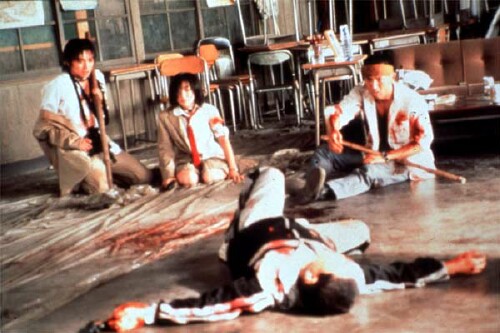
Regardless of any sociopolitical subtext, whenever you've got a movie featuring 13-year-olds brutally killing each other, it is going to be a cult classic. Battle Royale is extremely violent and has got compelling plot that never fails to keep your attention. Kids fight each other with all sorts of weapons and engage in all sorts of survival techniques, it is certainly fascinating. But there is also some great subtext about the divide between the world of adults and the world of children. The plot of the movie represents the disdain the filmmakers have for the inhumane dog-eat-dog world of adults, especially in a time of economic woes, such as the time Japan was in when this movie was made.

The actual details of the premise and plot are sometimes thin, which is not a flaw. Too much backstory would have taken away the allegorical quality of the plot, but there is some unclarity in the end that I would have liked to see improved. There's also a whole lot of unnecessary teenage melodrama, and much of it focuses on a select few characters making the question of who lives and who dies very predictable. But ultimately, the movie is extremely entertaining and leaves a whole lot of room for contemplation on the relationship between children and adults.

Grade: B

The Hunger Games (2012)


Director: Gary Ross

I reviewed this film for the newspaper and you can find that review here. I will say that I was surprised by the quality of the movie, but as it stands on its own it definitely would not be as popular if there were no books. I have not read the books, but I assume those are the reason so many people flocked to see this, all the non-readers, like me, just went to see what the fuss was about. While it's a quality film and there are things in it I greatly admire, I would advise you to make sure not to get your expectations too high. I certainly look forward to the sequel to see where the story goes, but I won't be expecting The Godfather Part II. 


Grade: B

Saturday, April 28, 2012

Game Change (2012)


Director: Jay Roach

 This is an HBO movie about the Republican side of the 2008 presidential campaign. I reviewed the film for the paper, and you can find that review here. I don't have much to say beyond the review. I will say that, having read the book the film is based on, the movie takes almost every thing from the book, and I'm fairly confident in the accuracy of the book so the movie should be fairly accurate as well. Even if specific scenes are not exactly accurate, I've heard from multiple credible sources that the spirit of the campaign caught in the film is certainly accurate.

Grade: B

Saturday, April 21, 2012

The Artist (2011)


Director: Michel Hazanavicius

 I reviewed this film for the newspaper. You can find that review here.

I don't have much more to add except to say that I really enjoyed the movie for what it is and I respect it for being so successful despite the obvious setbacks. There were better movies in 2011, but I don't expect the Best Picture winner to ever be my personal favorite film, because I'm not the one voting. So I will never complain when it goes to a good movie that I respect. Maybe it doesn't make audiences think too much, but it does make them think outside the box when it comes to silent movies, black-and-white movies, and old movies.

Grade: B