Showing posts with label United Kingdom. Show all posts

Tuesday, January 15, 2013

The Imposter (2012)


Director: Bart Layton

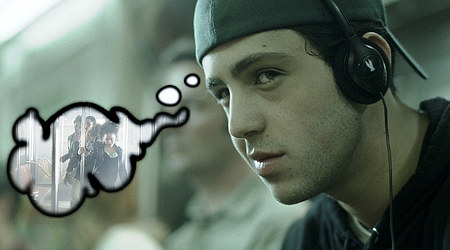
Coming into this film I had never heard of this story about a man who steals the identity of a missing child, and that I think improved by experience of this film quite a bit. Director Bart Layton takes a fairly  fascinating story about manipulation and manipulates it in his own way resulting in an absolutely wild ride of a documentary filled with twists and turns. Layton controls the audiences reactions in the film very effectively using things like manipulating interviews with subjects and making it seem like the interview subjects know just as much as the audience. It's also no secret that this guy is not actually the missing child this family has been looking for, which creates unbearable tension during early sequences in which the man meets this family. We know this guy is going to be revealed eventually, but we don't know when and we don't know how and that keeps the audience on its toes at all times. And I'm not even going to mention some of the later twists that come out of nowhere.

The Imposter is not just a great sensory experience (the first time you see it at least), but not a bad intellectual one as well. At first the film is an example of the extreme power of confirmation bias, not accepting something that may be against your preconceived beliefs. We see such an extreme form of confirmation bias in that a parent doesn't even recognize her own son. But in the final act of the film things get a little more muddled and unfortunately the movie brings up a point (I won't spoil it) that I thought was astonishing while watching, but in retrospect is the only example of Layton going a little overboard when it comes to manipulating the audience. That brings up the fact that the film is astonishing when you're watching the first time without knowing any of the story, but thinking back about the story (and maybe a second viewing) diminishes the impact just a bit. Ultimately I can't imagine anyone not having an extremely engaging experience with this documentary that asks us all question about truth, lies, assumptions, and manipulations.

Grade: B

Tuesday, January 1, 2013

Distant Voices, Still Lives (1988)


Director: Terence Davies

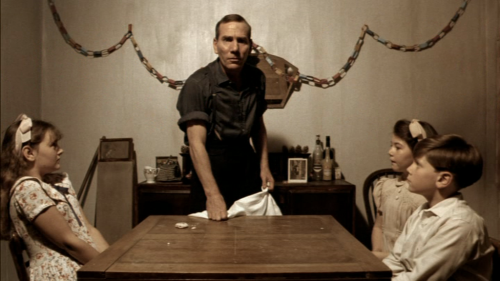
 With a runtime of less than 85 minutes it is astonishing how much this autobiographical work about a British family in the 1940's and 1950's actually accomplishes. It is in essence a portrait of a family (many of the shots are framed like family portraits), and Terence Davies gives us a complete portrait spanning decades in just 85 minutes. It seems like this movie should be a three hour epic, but Davies uses breathtaking efficiency, giving us a kaleidoscopically structured film that emulates the act of memory itself. The temporal structure of the film is hard to make out, but it all comes together in your own mind as a whole and lets you form your judgements yourself. The ephemeral efficiency of the film represents a truly unique masterclass in filmmaking by Davies. He gives us scenes that vary quite a bit when it comes to when they take place (in the first half at least), that tell us all we need to know about how this family of three worked. We learn how their now-dead very strict father's relationship was with each of the three children and their mother, how the children deal with his death, and how they continue on with their own adult lives.

The film really is completely unromantic and quite literally colorless. The colors are all dark, drab, and quite boring, representing a fairly mundane lifestyle that is only slightly cheered up by some group singing, usually in a pub. The music in the film is as important as any other aspect. Important music can live long in our memories, and so in the film the music tells us much about the character and how they lived their lives. For the characters themselves music is shown as a respite from all the bitterness and hardship that exists in Davies' depiction of post-war Britain. This is not a lavish Britain in which elegance pours over, this is a working class Britain hurt and ravaged by the memories of a war that came to their own doorsteps. Davies showcases this family, inspired by his own, as one of the many working class families of that time period that underwent what many families go through: pain, heartbreak, death, love, happiness, and regret. This impressionistic portrait of a family succeeds in such powerful fashion in showing what it really means to be a family, and how those complicated feelings we have towards our sometimes unreasonable family members always seem to inevitably come back to love.

Grade: A

Sunday, December 30, 2012

Skyfall (2012)


Director: Sam Mendes

 When you ask someone how a Bond movie was, they usually tell you by comparing it to other Bond movies. I personally can't do that because I'm not much of a Bond fan. I've seen my fair share of Bond movies, but I had yet to find any of them, besides Casino Royale, to be anything more than occasionally entertaining heterosexual male fantasies. But I did have somewhat high expectations coming into Skyfall due to Sam Mendes' involvement. It's probably safe to say that he has been the most high-profile (and probably talented) filmmaker to direct a Bond film yet, and so unsurprisingly Mendes delivered the goods, but not by being Mendes, but instead by taking a page out of the Christopher Nolan textbook. Mendes pulls a Nolan by giving us a spectacle-filled blockbuster with a resourceful and strong, but flawed, main character with a plot that is relevant to our world. While Nolan doing it first takes away some of the "unique" factor from Skyfall, Mendes made a movie almost as good as The Dark Knight and that in and of itself is impressive. Not to mention the fact that the cinematography by the legendary Roger Deakins is even better than anything Wally Pfister has shot in a Nolan movie (the Hong Kong skyscraper scene and the final scene with the burning house were especially shot beautifully).

Even Javier Bardem's extremely entertaining villain character seems modeled after the Joker, though I felt Bardem's character didn't quite connect with the rest of the movie as well thematically, he's a great character but one who seemed to be on the sidelines. But the film still succeeds. This could have been just a bland superhero movie, which is what Bond movies often times are, but in this film we see a vulnerable James Bond who is fighting the threat of old age. He struggles, his confidence is pushed to the limit, and his own personal history is brought into the equation. The main theme of the film, aging and fading relevance, is wonderfully woven in to not only reflect Bond the character, but also Bond the franchise. In the film M is asked the question as to why people like Bond are still relevant, and by the end of the movie we have a good answer to that question. But that doesn't just apply in the story, it's also a question about the Bond series itself, and ironically that self-questioning about why this series still exists is exactly why this particular film serves as a reminder as to why these movies can be worthwhile.

Grade: B

Wednesday, July 25, 2012

The Proposition (2005)


Director: John Hillcoat

 When we think of a western, we usually think of the old American west, but this great western is set in the barren lands of old Australia. The landscape is similar to the landscape of American westerns, but instead of Native Americans roaming around, you have Australian aboriginals. The best westerns are always the ones that manage to capture the desolate landscape and the effect the never-ending land and its savagery can have on people (last years Meek's Cutoff is the most recent film to capture this successfully). John Hillcoat directs this film paying close attention to larger thematics and dilemmas instead of focusing primarily on screenplay, which could have easily been made into a by-the-numbers action-western by another director.

Guy Pearce's character has a moral dilemma, and that is whether or not he will kill his wanted older brother for the sheriff in order to save his wanted younger brother who has been captured by the police from death. The film never takes a side morally. Even though Pearce's character and his brothers were involved in a horrible massacre of an innocent family, it's not easy to root against them because we see that the colonial police can be just as brutal. Flies, the insect, fly all over the place when we see the police, perhaps to symbolize that the "good guys" are just as "dirty" as the criminals. On top of all that, Nick Cave's music (he is also the screenwriter) makes the movie meditative when it needs to be and extremely exciting it when it needs to be as well. The music combined with the brilliant cinematography and Guy Pearce's great performance makes for a movie that's more of an experience than anything e lse. The screenplay is good, but it's simple. Hillcoat then takes the simple story and creates an emotional and even exciting film.

Grade: A-

Saturday, April 21, 2012

Downton Abbey: Season Two (2012)


Creator: Julian Fellowes

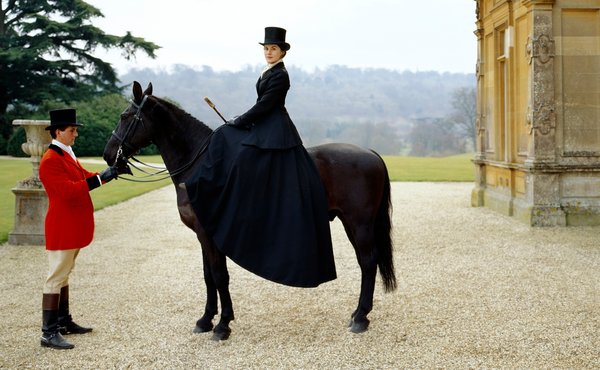
 The first season of Downton Abbey was filled with strong characters and a pretty compelling narrative for almost each of them. While the second season features many of the same strong characters, the narratives were not as compelling and much more silly. The believability of the plot decreased heavily as Julian Fellowes seems to dig deeper and deeper into the box of generic soap opera stories. Many of the plots were just contrived drama that weren't all that compelling, though at the same time the characters to make them watchable.

One of the more contrived and silly stories was the deformed Titanic survivor whose storyline was so unbelievable and out-of-place I wondered why in the world Fellowes chose to include it. On the other end, the romance between Lady Sybil and Branson was of similar quality to the character arcs in the first season, much more compelling and emotional while also shining a light on the changing times of the setting. Then there's one of the best parts of the show, which is just watching all the characters work together and interact. The overall tapestry of the house and the town they live in expanded during this second season and it helped in making the world of Downton Abbey a place you want to be a part of, even despite the sometimes unbelievable story-lines.

Grade: B-

Tuesday, March 6, 2012

The Arbor (2011)


Director: Clio Barnard

The first thing to know about this documentary is the unique lip-synching style, in which actors lip-synch real dialogue from interviews of real people. It's a pretty unique documentary method and Clio Barnard does it well enough that it offers a new way of making documentaries. It seems to give more freedom to the director to take real testimonies but frame them in any way the director sees fit. More power to the artist is something I am always for. The style also makes for some great scenes that question the difference between documentary and "based on a true story" fiction film.

The story itself starts off as a documentary about the life of playwright Andrea Dunbar's. Parts of the film are filmed scenes from the eponymous famous play of hers, and those plays give us a very inside look at Dunbar's life. But the film eventually turns into a movie about her first daughter, Lorraine's. It's a long downward spiral that is sad, but not new or original and has many of the same lessons we're already used to. The subject doesn't seem completely worthy of the stylistic treatment that Barnard gives, but the style itself is unique and for documentary fans I'd recommend it just for the style.

Grade: B

Thursday, March 1, 2012

Downton Abbey: Season One (2011)


Creator: Julian Fellowes

I was never a fan of stories of the period pieces about the British class system, so any enjoyment I get from this show is not because I adore the genre. The first season of Downton Abbey is a surprisingly intricate, nuanced, and well-written drama about love, inheritance, and class. The themes of the show are certainly not original, neither are the character types. It's not one of those shows that will sound all that appealing to most people who are not already fans of English literature. But the show has these characters that are so compelling, and they are all acted in such a way that transcends any and all the cliche's associated with those characters.

It is remarkable how the characters and their relationships with each other are so nuanced even though on paper the relationships would be so standard and conventional. The biggest reason the show stands out to me is the relationship between the upstairs royalty and the downstairs servants. Each have their own culture, but when those cultures meet is when the show does great work. All of it helps in telling a story that is also about the culture these characters live in, one that is changing in terms of family roles, gender relations, and also class relations. The show doesn't seem to criticize the class system, but it recognizes the changing perception and tries to capture the change in motion. It is a show that oddly respects the class system while not mourning it when it is clear that tradition is changing. The show is not at all as sophisticated and well-written as Mad Men, but it really is the British Mad Men of the 1910's.

Grade: B+

Friday, February 24, 2012

Weekend (2011)


Director: Andrew Haigh

This film is a simple gay indie romance that puts the emotions and feelings of its character at the forefront rather than politics or sociological issues. The story and structure is nothing new, neither are the characters when you take away their homosexuality. But the film is realized in such a simple and affecting way and you find yourself completely connected with the relationship of these two men. The film isn't showy at all and the dialogue feels very real. The movie does not present an obvious romantic tone, nor does it present a cynical tone, it just presents reality. Prominent issues facing gay people are brought up, but not focused on, and so the movie doesn't alienate itself. Andrew Haigh does a standout job at directing in this film. The tone is completely controlled and the chemistry between the actors is completely controlled as well. The visuals in the movie seem improvised and meticulously composed at the same time. It's a simple romance, but one that is more effective than most.

Grade: B

Thursday, February 23, 2012

We Need to Talk About Kevin (2011)


Director: Lynne Ramsay

Parents usually cite their number one goal to be to raise their children to be great people who are better than their parents were. In We Need to Talk About Kevin the complete opposite of that happens, and we see a mother grappling with the question of why this happened and what went wrong. In this film the titular Kevin ends up going to jail for a Columbine-like massacre at his high school, but it's not about him, it's about his mother and the complicated issues she goes through. It's a horror movie for parents.

The movie has a fractured narrative, in the sense that we see Kevin's mother, Eva, played by Tilda Swinton, during her life after the massacre, and we frequently flashback to scenes from before the Massacre. We go from Kevin as a baby all the way till the massacre, but the scenes of his mother in the present day are necessary because they establish that the scenes we are watching in the past are not exactly objective. Eva is a mother who is questioning whether or not it was her fault for what Kevin did. Through the flashbacks we understand that Eva is going through an inner conflict. Eva lived a fantastic life as a travel writer before Kevin was born, and having a baby seemed to have made her life a lot more dull, something she did not like at all. Part of her feels guilty for that and possibly sees her disdain for the child as the reason this happened. But we also see that Kevin is a pretty horrible kid in the flashbacks, so it's possible that this was an inevitable act that was bound to happen no matter how Eva raised him.

Lynne Ramsay does an incredible job at establishing the dread-filled mood that accompanies Kevin in every scene. Every horrible thing he does is highlighted completely because we see Kevin as Eva sees him. Ramsay infuses the film with the color red, because thats the color that stands out to Eva as she reminisces about her killer son. We Need to Talk About Kevin is a movie I hope to watch again someday soon because I'm not sure I was ready for the bait-and-switch it does by seeming like its based on realism, and then ending up completely and incredibly subjective. But as I reflect about the movie more, I find it a greater and greater achievement that puts us smack dab in the mind of a tortured mother.

Grade: B+

Friday, February 10, 2012

Tinker Tailor Soldier Spy (2011)


Director: Tomas Alfredson

If you've seen Tomas Alfredson's previous film, Let the Right One In then you know a bit about what to expect with his newest film Tinker Tailor Soldier Spy. What Alfredson does to horror movie conventions in Let the Right One In he does to spy movie conventions in Tinker Tailor Soldier Spy. It's a subtle and quiet film that avoids giving the audience the action scenes and plot twists that they expect from movies like this. Instead of the mystery of who the mole is, it is the atmosphere and the personal stories that make this movie so special.

If you have not read the book or seen the BBC miniseries adaptation of the book, like I did not, then the first viewing of this film will almost certainly be filled with some confusing moments. But after you leave the theater, things will pop into place and it will all make sense. I have seen the film twice now and on the second viewing I can confirm that everything does make sense and is all connected in an incredibly intricate and elliptical way. The screenwriters had a huge book to adapt and they did so in a way that avoids spy movie conventions but still offers just enough information for the plot to make sense.

More important than the plot though are the people involved in this hunt for a mole and the world that they inhabit. They work in a cold and stoic bureaucratic world that has made no room for personal desires, but as we learn in the film it is exactly those personal desires that keep creeping up. Alfredson and his actors, Gary Oldman in particular, create a distance to their characters, we're not supposed to know them because that's how this world works. But we learn that as much as these people try to repress their inner desires, those passions and wants will always come into play and influence the most stringent of institutions.

(I also reviewed the film for the Daily Evergreen, which is more or less the same as this but a bit longer. You can find that here)

Grade: B+

Tuesday, February 7, 2012

A Dangerous Method (2011)


Director: David Cronenberg


This isn't a great film, but I feel like it will eventually become an essential part of David Cronenberg's career. A Dangerous Method boils down so much of the thematic material in Cronenberg's earlier films, which makes the fact that it's basically a talky period drama not that surprising even though it should be. Both Sigmund Freud and Carl Jung are the main characters of the film, and their studies on human sexual behavior and psychoanalysis were probably studied by Cronenberg many times when he was making his earlier body-horror movies.


So the subject matter and all the conversations that Freud and Jung have are directly related to Cronenberg's sensibilities, and if you're a huge Cronenberg fan it's definitely a must watch. But I'm not sure it's a great movie. The film does not have a singular focus, instead it tries to be a film about the birth of psychoanalysis, the rise of a young psychologist studying under Freud, and a love story between a patient and her psychologist. The elements in the film were certainly connected, but tf it wants to satisfyingly tackle all of these stories it should have been much longer than the 99 minute runtime.


It may not have been exactly what I wanted, but A Dangerous Method is still always completely fascinating. This battle that Jung has between repressing his sexual desires and staying true to the monogamous relationship that he believes he must uphold makes for some inner conflict that is thrilling to behold, especially for a figure as educated and intellectual as Jung. I certainly was engaged in intellectual thought while watching and listening to Jung, Freud, and the very entertaining Keira Knightley, but it was the result of the dialogue and the real life figures in the film, rather than the filmmakers.


Grade: B-

Friday, February 3, 2012

Project Nim (2011)


Director: James Marsh


Humans have always tried to anthropomorphize animals, be it in Hollywood movies or putting clothing on our own pets. In the documentary Project Nim a scientist tries to take this to the next level, he takes a baby chimp and intends on raising it like a human and teaching it sign language. Whenever a documentary or fictional film is made about a scientific experiment, it's almost always about a scientific experiment gone wrong, so it's no surprise that the experiment does not really work out as planned.


All the people involved in this experiment are seemingly noble people, they display real affection for the chimp (they name it Nim Chimpsky). But eventually, their noble intentions are not enough, because the whole project is misguided from the beginning. Eventually we see them learn that animals are animals, and trying to humanize an animal will not make them humans. Nim's story ends up being tragic and devastating, and it's unfortunate that it turned out this way. The only thing the movie is missing is a third act uprising by the monkey to turn it into Rise of the Planet of the Apes.


Sometimes the tragedy of Nim gets dragged on a bit too long in the film, and director James Marsh takes advantage of our sympathies with animals a bit much as well. But the tragedy was real, and it's a shame that a chimp had to go through such a terrible life because a few people wanted to see what would happen if they tried to raise a chimp more like a human. In Project Nim we see how the treatment of animals will usually reveal a lot about the carelessness of humans for other creatures. It's not particularly surprising, but it's still a sad truth


Grade: B

Monday, January 30, 2012

Filmcap: The week of Dec 18-25


Shame is the only film that will be reviewed in this post. I will likely be switching to a one-movie-per-post format after I finish up with all the filmcaps for the year 2011, which is just one more after this post. You can also look for my long-awaited best films of 2011 very soon, working on that now. 

Saturday, January 21, 2012

Filmcap: The week of Dec 4-11


Raise the Red Lantern. Certified Copy, and Sideways are some of the films reviewed this week. I continue my catch up on 2011 films and I find one true masterpiece as well as two interesting but a bit standard works. In addition, I check out two films by renowned directors, one American and one Chinese, both with new films out this year. In this post you'll find films about second chances, coming together in the face of hardship, and why authenticity may not matter. 

Tuesday, December 20, 2011

Filmcap: The week of Oct 23-30


Don't Look Now, Hoop Dreams, and Morvern Callar are some of the highlights from this productive week of movie watching. In this post you'll two "adaptations" of classic novels by two very different authors, two mesmerizing movies about the different ways people deal with grief, and also a movie with a typewriter that is a bug. Many more reviews of 2011 movies that I'm catching up with coming in the coming posts. Now that it is winter break I hope to catch up a bit with these posts. Also, the movie posters for the movies this week are all pretty good (except for the In Time one).

Saturday, December 10, 2011

Filmcap: The week of Oct 16-23


Vagabond, The Constant Gardener, and The Messenger are some of the movies reviewed this week. There's also a little bit of a World War II theme with Resnais' Night and Fog and Truffaut's The Last Metro, both French films coincidentally. In this post you can also find some words about how people view free spirited people, how we can avoid another Holocaust, and the different ways we all grieve. 

Monday, October 31, 2011

Filmcap: The week of Sept 25-Oct 2


Repulsion, Viridiana, and My Night at Maud's are some of the highlights from this quality-filled week. You've got classics from Luis Bunuel, Eric Rohmer, and Roman Polanski. If you're a fan of Catholic guilt and religious confusions then you'll love the first two movies in this post. You'll also find a review on my one and only 2011 documentary I've seen so far and also a review on one of the few British TV shows I've seen. 

Tuesday, September 27, 2011

Filmcap: The week of Sept 4-11


Fish Tank, Grand Illusion, Funny Games, and recently completed season of Louie are highlights from this abnormally great and lengthy week. Minimal amount of schoolwork, a realization that this is my last year of school and thus last chance to really go all out with my movie watching, and also the ending of two television show seasons all culminated in a lot of entries for this week. In this post you'll find discussions on how the differences between a great miserabilist film and a bad one, the benefits of personal filmmaking, and the lack of intellectual provocation in the movies. 

Monday, September 12, 2011

Filmcap: The week of Aug 21-28


Highlights from this week are "The Wackness" and the surprise of 2011, "Rise of the Planet of the Apes." This week's post marks the start of the school year and with that, more movies every week. I usually have one new movie a week that I review for The Daily Evergreen, but this week I saw a film on a Sunday opposed to a Friday or Saturday and so "Rise of the Planet of the Apes" is in this weeks post as opposed to last week. Included in the reviews are discussions on the paradox of a movie about how important books are, and the importance of authenticity in the effectiveness of a familiar story. 

Wednesday, August 24, 2011

Filmcap: The week of July 10-17


This week I watch two "kids" movies. One of them is rated PG-13, and the other is rated PG. I am willing to bet that more 10 year old kids saw the PG-13-rated movie than the PG-rated one. I talk about how the Harry Potter movies will be remembered forever, but not for their quality, and I also revisit a sweet film I've already reviewed on the blog before.