Showing posts with label Steven Spielberg. Show all posts

Friday, January 11, 2013

Lincoln (2012)


Director: Steven Spielberg

 The title of this film makes it seem like it will be a full-fledged biopic of Abraham Lincoln's life, from the cradle to the grave, and reportedly that's what the filmmakers, Steven Spielberg and Tony Kushner, did plan on in the beginning (he's one of my favorite historical figures so I would have been fine with that too). But instead, we get a film titled Lincoln that almost completely takes place within the time span of a few weeks in January 1865. The decision to center on just those few weeks during the battle to pass the 13th Amendment in the House of Representatives turns out to be a brilliant move. Lincoln is not a scattered biopic about a man, but a film about a specific moment in time that serves as a perfect example of the kind of man Lincoln was. The passing of the 13th Amendment shows us the self-interested world Lincoln occupied, and how he managed to the reality of the world and his own ideals together to actually achieve his goals while preserving the Union. It essentially looks at the main conflict of all politicians, which is to achieve the personal ideals each of them have while occupying a place within a group of people who all have so many various goals in mind.

But this is not just a fantastic film about Lincoln, because by showing us Lincoln's pragmatic nature Lincoln also turns out to be one of the best films I've seen about the nature of politics and democracy. The film may be centered on Civil War-era politics, but it is a film that applies to the politics in any part of the world at any time. Spielberg and Kushner aren't afraid to be remarkably honest about the often dark nature of politics. It's not a cynical movie about how everything is corrupt because we do see success, but it's also not naive about how that success was achieved. The passing of the 13th Amendment was a great accomplishment, but we see the not-quite-ethical tactics used and deals made by the men of the era that ended up aiding in the abolishment of slavery. Many have accused Spielberg in the past, myself included, of being too sentimental and naive in many of his dramas, but with Lincoln Spielberg has uncharacteristically made a procedural that is more grounded in its approach. Especially when compared to last year's overly sentimental crowd pleaser War Horse, Lincoln is a film that is not afraid to get down and dirty and look at the unflattering ways great things happen. Lincoln the man is a genius not because he believed in a higher ideal and inspired everyone around him to take a stand, but he we see that he was a genius because he was a pragmatist who knew how the world worked and knew how to get things done. Lincoln is a great film precisely because it does not show him as a saint, but as a great politician with a heart.

Grade: A-

Wednesday, February 8, 2012

War Horse (2011)


Director: Steven Spielberg

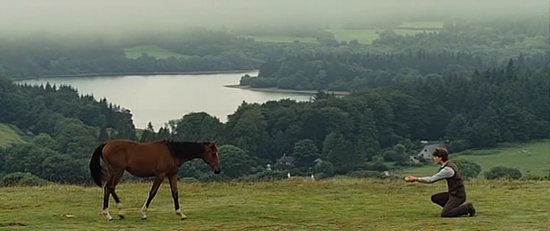
I reviewed War Horse for the newspaper and you can find that review here. In short, it's a well intentioned film, but it feels too tame to be all that effective. It's more Spielberg's direction than the story that's a problem, the story of following a horse through a war is unique and prime for insight, which is why I wish Spielberg hadn't directed it in such a way that made it easy to digest and appealing to a family audience. What animals, and especially horses, went through in wars like these is not something that is completely family friendly, and it's better to reflect reality rather than try to turn in reality into something that will go down much easier. I will point out though, that visually the movie is usually beautiful and it takes full advantage of not only the locations but also the majestic beauty of the horses.

Grade: C+

Sunday, May 1, 2011

Filmcap: The week of April 17-24


So I am officially about a week behind on these because of finals. Though I think I'll be able to catch up soon once finals die down. This week I finally finish Band of Brothers, some Italian World War II stories, one very artistic Iranian film, one very Hollywood-ish Iranian film, and two movies about bank robberies.


Monday, September 28, 2009

Review: Schindler's List (1993)


Synopsis: The true story of Oscar Schindler (Liam Neeson), a German businessman who owns a factory. He witnesses the horrifying visions of the Holocaust and the toll it takes on the Jewish people. Eventually, he creates a list of over 1100 Jews whom he saves from death.


"Power is when we have every justification to kill, and we don't. "

Steven Spielberg released Schindler's List in the same year as he released Jurassic Park. The fact that the two films are entirely different yet both great films in their own right is a testament to Spielberg's versatility as a filmmaker. He can make a brilliant black and white World War II Nazi-Jew movie, and a wonderful movie about dinosaurs alive in modern day, without missing a beat. Both films successful in their own right.

Schindler's List is one of those movies where it might not be everyone's favorite film, but also one where no sane person can deny that it is a very good film. If a movie can do that to an audience, then that film becomes a cinema classic. Films that polarize audiences don't become classics, it's the films that everyone can agree on. Almost everything done in this movie was the way it should have been done. The casting proved to be perfect, and the acting was outstanding. Liam Neeson portrays Oskar Schindler with just the right amount of subtlety needed. During most of the course of this 195 minute film, we are not sure what Schindler's motives are, if he is really just in it for the money, or if he really does care for the Jews being massacred. Towards the third act of the film we can pretty much tell he just feels bad for them, but that had to be done in order to create the legacy of Oskar Schindler that Spielberg worked so hard to create. The supporting cast of Sir Ben Kingsley as Schindler's right hand Jewish accountant and Ralph Fiennes as the evil Nazi officer were great as well. Though Ralph Fiennes character was not given enough background I thought. Even though they are Nazi's, I still believe it is not fair to show them as just crazy people with no feelings. Regardless of the reason they had, there was still a reason they were killing Jews and that I thought could have been spelled out for us at least once or twice. But even that fault was just a minor fault, since the movie is not about Nazi's, it is about the Jews who suffered through Nazi rule.

I was cautious at first about the film being in black and white, I wasn't entirely sure about why it was in black and white besides being done for pretension's sake. But as the film went on I started to really enjoy the cinematography and the beautiful use of lighting in the film. There are not a whole lot of black and white movies that were shot in black and white on purpose. Most were shot in black and white because color was either not available or too expensive, so when you choose to shoot in black and white over color, then you better use it well, and this movie succeeds in doing that. So the fact that it looks great, takes away a lot of the issues I might have had with finding the real reasoning for the black and white cinematography choice.

One minor quip I had with the film, was that it was done all in English, with lots of German and Polish accents. Everything that we didn't need to hear was done in German or Polish, but all the main dialogue was in English. Now even though the film might not have been received as well as it was, myself included, shooting it in German and Polish would have lent it more credibility and I would have respected it a little more. But many things, such as casting and focusing on the reading rather than the images, would have had less of an impact if it was not in English, so it was a choice with its pros and cons and I am sure the filmmakers realized that, and the financial incentive of shooting it in English probably was a deciding factor.

Schindler's List is a highly important film. The images, the words, and the context behind the film are important to understand. It is important to know the story of Oskar Schindler. Spielberg heard the story, and realized how important it was that people hear it. He understood the importance of the story, and made sure his film told it in the best way possible. This film is important in a way that, say, Tarantino's recent Inglourious Basterds is not (a film I thoroughly enjoyed by the way). Tarantino's film was not made to provide insight into the events of Nazi-Occupied Germany, it was made with assumption that most people knew the events of Nazi-Occupied Germany(probably at least in part because of Schindler's List), and then played around with the true events, making the film fun and highly entertaining, but not important.

Steven Spielberg has many great films under his belt, and if I think about it enough I might even personally prefer one or two of his other films over this one, but if I heard someone proclaim that Schindler's List is the magnum opus of Steven Spielberg's career, I would be hard-pressed to find a reason to disagree with that.


Fun Note: This film is one of two Best Picture winners to have a scene in which a child jumps into a bunch of poop, the other being Slumdog Millionaire.