Showing posts with label France. Show all posts

Wednesday, January 23, 2013

Holy Motors (2012)


Director: Leos Carax

 It is not too difficult to appreciate this film, or to admire this film, or to enjoy this film, but understanding what it all means it is a different story. There is a lot going, and deciphering every single thing about this film may prove impossible on a first viewing. But when looking at the film overall, it's quite simple. We see an actor do rides around a limousine over the course of a single day doing nine different "appointments". He acts as an old lady begging in the street, he performs on a motion capture stage, he plays a father picking up his daughter from a party, he plays a sewer creature who kidnaps a model, he plays an old man on the verge of death, etc. The odd thing about these "appointments" is that there are no cameras or audience around, at least not visibly. He is performing these acts in the real world. The film hints that digital cameras are so small now, that they are invisible.

The film is a remarkably unique film in that every one of the "acts" Denis Lavant's character performs performs are executed to perfection. While the film does make sense as a whole, it's certain that director Leos Carax also wanted the opportunity to tackle all sorts of genres in one movie (it's his first film in 13 years, so he has a lot of catching up to do). He tackles these familiar genres because these genres are the "typical" entertainment we have in our lives, and because we are always performing for the omniscient camera, these genres become our reality. The digitalization of not just cinema, but of everything in our culture, has made it so in our constant performance for the camera we have lost our sense of identity. Our identity has slipped away behind the veneer of technology and the ways we choose to portray ourselves to the world. With its unique ambiguous structure, Holy Motors shows that truth in identity is slipping away from all of us in our increasingly technology-dependent world. Through it's multiple "episodes" Holy Motors is a mystifying, powerful, sensational, and thought-provoking film that tells us much about who we are and where we're going.

Grade: A

Friday, January 4, 2013

Rosetta (1999)


Directors: Jean-Pierre and Luc Dardenne

 It is a rare and impressive thing when a filmmaker can craft an intimate and personal film while also bringing with it such broad social and political implications. The film is an uncompromising look at a 17-year-old girl who lives in a small trailer with her good-for-nothing mother trying to find a job. She's a girl who is desperate for any sort of job, but she's also a principled human being who just wants to have a normal life. Her desire for a job has to do with money, but it's also about being a normal member of society, and that's what gives this film added poignancy. The Dardenne brothers use their typical handheld jittery up-close camerawork, always following our main character, and frequently in tight close-ups. It gives this deeply personal look at a life in motion even more intimacy, but at the same time it manages to also be about the larger issue of the difficulty that those on the fringes of society have in entering into society.

One of the reasons I will cherish and remember this film for a long time is because it's not an idealistic film like so many others are, it's not a contrarian movie about the ills of society. The film does not take a stance against the idea of modern society, instead it just says that society needs to do more to help those who want to enter modern society. It's a very pragmatic movie and not one with high-minded ideas, and that's a very unique stand to take in intellectual art. Rosetta is essentially a film about the lack of social mobility, and the difficulties people have in obtaining an honest living. It's telling that Rosetta refuses to do any illegal jobs in this film, because she is a person with respect and principles, a quality very deserving of entering society. She does have to engage in a personal betrayal later in the film though, which is not illegal, but certainly only hurts her social life. That betrayal shines a light on the how obtaining even honest work can be a very anti-personal endeavor, because in this economic system personal relationships must be second to money and success. What's more amazing is that none of these messages are said out loud, everything is implied. It's a movie that shows you the life of one person on the fringes of society and forces you to make your own conclusions about why this girl is having so much difficulty. It manages to be political by way of being personal.

Grade: A

Wednesday, December 19, 2012

The Lovers on the Bridge (1991)


Director: Leos Carax

I really like this movie, but I think much of that like is based on admiration rather than actually connecting with the film emotionally or even intellectually. I love that this film is a romance between two homeless people, a small subject, but is so ambitious in filmmaking and scope. Director Leos Carax re-built the the oldest and most famous bridge of Paris in a countryside and uses it magnificently. It's obvious his camera angles were never restricted, as he gets all sort of angles, all sort of freedom on this bridge. It's most obvious in a brilliant nighttime sequence on the bicentennial celebration of Bastille Day, complete with fireworks and a wide-range of loud music. But not only does the scope give us the visual spectacle, but also a full fledged romance from the beginning to the end. Carax is given free reign and is never afraid to go all out.

The film is centered on a romance between two odd homeless people: a guy who eats fire and can't sleep without medication (played by Denis Levant, brilliant as always), and a girl who is recently homeless and is going blind (played by the great Juliette Binoche). Both actors make this odd romance work wonders and makes the films celebration of odd love work. Both people live in a brutal world, and only find solace in each other. It's a way to show that love can be a way out of brutality, but Carax is also not afraid to show that love itself can be brutal as well. At least, that's what he's going for. It all works on paper really well, but Carax walks a fine line between his massive scope and the emotionality of the story, and he doesn't always make it across. The movie can be incredibly impressive at times and Carax shows that he is a great filmmaker, but many scenes don't add much at all emotionally. But I found The Lovers on the Bridge to be a magnificent achievement, it's a film about an intimate story made large and epic, and that's what I want to see more of.

Grade: B+

Monday, December 10, 2012

La Jetee (1962)


Director: Chris Marker

 The opening credits of this short film bill it as a "photo-novel". A fairly accurate description, as the 28-minute film is pretty much completely made of nothing but black-and-white still images. It sounds like it's mostly an experiment in form and that the still image format is just some experimental gimmick, but this film actually works brilliantly on every level. The still images bring cinema back to its roots. Cinema is basically a bunch of photos shown in quick successive motion (24 frames a second usually), so this film just does it all in much much slower motion and proves that it is the illusion of movement that creates the illusion of linearity that makes film so powerful as a format. Director Chris Marker then equates that with how our memory works, which directly ties into the subject matter of the film, which is time travel.

The main character of the film has a strong memory, an image of a woman he once saw before the world had been destroyed and everyone moved underground, and the strength of that image gives him the mental stamina that allows him to be the perfect guinea pig for a time travel experiment (this film was the inspiration for Terry Gilliam's 12 Monkeys). The movie gives us the poignant notion that memory is basically a form of time travel, that memory is a way for us to back in time while time is really moving forward. It's the perfect story for a film made with still images. Photographs are memories, and for the main character the memory in his head was so powerful that it enabled him to go back in time, just like how movies (photographs in quick motion) can be so powerful that they can enable us to feel like we're going back in time. It's amazing how visceral a movie that has no motion can feel. La Jetee is maybe the most intellectual film about time travel I've ever seen, Marker uses time travel not as a gimmicky plot conceit, but a way to look at the human minds relationship to the world around it. It's an amazing accomplishment that a 28-minute black-and-white film with nothing but still images can be simultaneously about the nature of memory, the nature of time, and the nature of cinema itself.

Grade: A

Thursday, July 19, 2012

The Beat That My Heart Skipped (2005)


Director: Jacques Audiard

 A French crime film that happens to be a remake of little-known American film from the 1970's, when a movie has that description, it's bound to be at least worth a watch. This is the film Jacques Audiard made before A Prophet, a film I believe to be a masterpiece, and it's obvious after watching this film that A Prophet represented Audiard reaching the top of the potential he shows in The Beat That My Heart Skipped. The movie is very well-made, there is some raw filmmaking and also some very raw acting by Romain Durais. Both Durais and Audiard are the ones who deserve credit for creating such a raw and gritty film that really works, despite the fairly standard and sentimental story.

The story is right out of The Godfather, a young man whose family is involved with crime would like to get out of the criminal world but his responsibility to family ends up making it difficult to do so. In this film it's made even more obvious and sentimental because our protagonist wants to be a piano player, the complete opposite of a guy who hurts people for money (it's a little too on the nose). The issue of filial responsibility is what is most interesting in the film. It's been done before, but this film adds an interesting aspect with the introduction of the debt concept. Your parents took care of you, you have to take care of them, and that's even if they get into hurting people for not paying them back. You can see the irony and that the theme of debt is quite clear. Even though the ideas in the film are not very unique, the film is well done enough to make it a quality piece of art.

Grade: B

Wednesday, June 6, 2012

Stolen Kisses (1968)


Director: Francois Truffaut

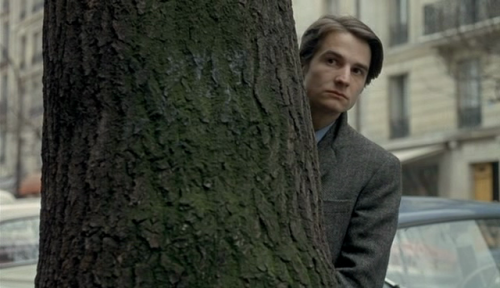
 Previously I reviewed Antoine and Colette, the second film in Truffaut's Antoine Doinel series. This film here is the third. One of the first things that stands out in this film is the performance of Jean Pierre Leaud and how he has so perfectly evolved into the character of Antoine Doinel (or maybe the character evolved into him). His acting, plus Truffaut's writing and directing since the character is semi-autobiographical, all do so much to get across all the ticks and small characteristics that make Doinel who he is.

In this film Doinel is largely the same person he was in The 400 Blows and Antoine and Colette, but in a much more adult world. Once again Doinel is a guy who just can't find his place in society. The way he goes from job to job, and from young woman to old woman in the movie is proof of his inability to have a stable life. Doinel just can't find where he's supposed to go in society, and it's a theme that I believe many can sympathize with in some way. While there are many great comedic moments, ultimately the film is once again a tragedy in which we feel bad for Doinel and blame society for being so uninviting.

Grade: A-

Antoine and Colette (1962)


Director: Francois Truffaut

This is just a short 30-minute film which continues the story of Antoine Doinel who you may remember as the main character of Truffaut's first film, The 400 Blows. In this short film, we see Doinel as he experiences love for the first time. On its own, this film is not all that special, it's just really a well-made short film about a guy who falls in love with a girl who may or may not feel the same way, quite simple and nothing unique really. But seen in context with knowledge of The 400 Blows and Doinel's character, the movie takes on much more emotional resonance. It becomes a tragic love story of a kid who just keeps getting the short end of the straw, and because of that we really get invested in the character and sympathize with his troubled life. Doinel couldn't find his parents love, and now he can't find a woman's love.

Grade: B

Friday, May 25, 2012

Jean de Florette/Manon of the Spring (1986)


Director: Claude Berri

 I'm writing about these two movies as one because they're basically one four hour long movie. They were intended as one and only split because they would be quite long to watch at once for most people. Both films would be fairly flawed if experienced individually. But as a whole they are an engaging viewing experience that serves as a morality play of unintended consequences. The film has a sold narrative, identifiable characters, and easy messages. The movie is a period pieces based on a book, so it's basically equivalent to the awards-bait type movies we see here in the United States, but that does not mean its bad.

The long running time allows for the film to breath and the pacing is smooth and easy. The movie is relaxed, but never too slow. The payoffs of the film though are not all that surprising or emotional which they're supposed to be. The story is predictable so the payoffs aren't too effective on an emotional standpoint, but the messages of those payoffs are definitely felt, though they aren't completely unique. In the end the film is one of those period pieces that would have won all the Oscars if it were made in America, so depending on how you feel about those kind of movies, this may or may not be for you.

Grade: B

Monday, May 21, 2012

The Big Blue (1988)


Director: Luc Besson

 This film is epic, sprawling, meditative, and tranquil. So normally I would love a film like this, but unfortunately, Luc Besson just does not have complete control over his epic narrative and it stumbles frequently. It is not a focused movie thematically or narratively. It tries to be a movie about a man who has a loving obsession with the sea, and a movie about a lifelong rivalry between two great swimmers all at the same time, and there's also something about dolphins.

Much of the film is touching and quite interesting, especially when the movie focuses on the swimmer who is obsessed with the sea and how that obsession makes him a very unsociable human being. That situation makes the romantic subplot of the film quite unique. But the film loses focus eventually. I still greatly admire The Big Blue because what it does right it does very right, but it is not a movie I can say I am a fan of due to its inconsistency. But I will never discourage any filmmaker from trying to make a movie that is this epic and tries this hard. Next time, try a bit harder.

Grade: C+


Monday, April 23, 2012

Playtime (1967)


Director: Jacques Tati

I guess technically this film is a comedy, but I am absolutely positive that there is no other comedy like this one. This is a film that is a satire against the modern urbanization that makes the world an impersonal place filled with blandness and a machine-like lifestyle for everyone. It also displays the illusion so many of us live in, our pre-conceived cultural and societal notions that bar us from seeing the negative effects of urbanization and globalization.

It's a very long movie that is composed of many gags and individual scenes rather than one straightforward plot, but it's the images that do so much of the storytelling. The film was shot in 65mm, and the widescreen compositions are immensely detailed and choreographed. This film uses the visual image better than almost any film I've ever seen. There is hardly a main subject on the screen, rather, everything going on in the frame is important, even in the corner of the screen. There is an extraordinary amount of details filled in one image. Playtime is an absolute masterpiece that I will definitely be seeing again. It is a highly ambitious film with very elaborate sets, and it all plays amazingly well.

Grade: A

Saturday, April 21, 2012

The Artist (2011)


Director: Michel Hazanavicius

 I reviewed this film for the newspaper. You can find that review here.

I don't have much more to add except to say that I really enjoyed the movie for what it is and I respect it for being so successful despite the obvious setbacks. There were better movies in 2011, but I don't expect the Best Picture winner to ever be my personal favorite film, because I'm not the one voting. So I will never complain when it goes to a good movie that I respect. Maybe it doesn't make audiences think too much, but it does make them think outside the box when it comes to silent movies, black-and-white movies, and old movies.

Grade: B

Friday, April 6, 2012

Contempt (1963)


Director: Jean-Luc Godard

 This film was Godard's first, and only, relatively big budget film with star power. Bridget Bardot stars in the movie, but Godard makes us ultra-aware of not only her star persona, but the big budget nature of the movie. He takes on commercial filmmaking while making a commercial film, and one of the ways he does that is in the opening scene, which plays on Bardot's physical beauty and his producers requests to objectify it. He also parallels his own story with the director of the film-within-the-film played by Fritz Lang (playing himself). The main character is also a screenwriter worried about selling himself out, but needing money.

But the movie still works as a pure emotional experience as well. The break up between the two leads is one that is done thoughtfully and authentically. Almost the whole second act takes place in an apartment where an argument between the couple is taking place, and while that scene is unusually long, it feels completely honest. Both of them have real problems that real people would have, and the way they argue is also completely accurate in the way that they are arguing but do not completely hate each other. Godard proves himself with his ability to capture genuine emotion and issues, but also can comment on commercial filmmaking with his experimental filmmaking techniques. It is a marvel to watch.

Grade: A

Friday, March 23, 2012

The Rules of the Game (1939)


Director: Jean Renoir

 Satires of the upper class have been done in film time and time again, but The Rules of the Game is one of the first, and maybe the most scathing of them all. It is technically a light satire (this film likely influenced Bergman's Smiles of a Summer Night, which I reviewed recently), but that satire is not afraid to be extremely harsh and critical. The film consists of a large number of French bourgeoisie who are in a estate together for a vacation, and in this "vacation" we see how their fake rules force them to do things that are sometimes nonsensical, and sometimes completely inhumane.

Renoir does not criticize them to the point of dehumanizing them though, the humanity of the characters is intact but, like in Renoir's Grand Illusion, the artificial constructs of society are what make these people act so idiotic. Renoir does a masterful job with a story with so many characters and still keeping it coherent and flowing. The film moves seamlessly from scene to scene, from character to character showing everyone and in all their messed up glory. This is all just surface level analysis, because there is so much more underneath that can be taken away from this film with multiple viewings. This is one I will definitely revisit.

Grade: A

Thursday, March 15, 2012

M. Hulot's Holiday (1953)


Director: Jacques Tati

 A very charming and amusing comedy that feels very much like a silent comedy of the 1920's. Tati uses pantomime and slapstick comedy in a movie that technically has sound, but actually has very little dialogue. The movie uses sound in its comedy, but almost none of the comedy comes from the dialogue. What's also impressive is that it succeeds in creating an evironment and setting that is individual, and seeing the same bunch of characters over again helps create that world.

Most of the vacationing guests are rich and continue to do what they like to do despite Tati's shenanigans, and that makes it a gentle satire on that upper class lifestyle. But that's not to say that it's some scathing satire, the film is very light. The movie is composed of gags after gag, instead of a narrative, and that makes for a very effective comedy but I'm not so sure I was prepared for that style. The film is enjoyable, but it is not something that is all that deep. It's one of those movies thats a must-watch for fans of the style, but not all that necessary for everyone else.

Grade: B

Monday, February 27, 2012

Cave of Forgotten Dreams (2011)


Director: Werner Herzog

This Werner Herzog documentary about the oldest cave paintings ever found is a pure treat, not only because the cave the documentary visits is not open to the public, but because we have Herzog as our tour guide. Herzog asks some fascinating questions about humanity, the beginnings of art, and even goes into the topic of spirits. His narration keeps you thinking and interested while his cameras focus on the painting. The movie celebrates both primitive art and the newest technologies simultaneously as he talks to those behind the exploration and preservation of the cave.

The cave itself is completely fascinating because it's been so well preserved, and so going into the cave is like stepping into a time machine and going back thousands of years ago. Herzog does take some detours  in which he explores a bit about how the people who may have done the paintings lived, but during those moments we're just waiting to get back to some more exploration of the cave. The movie was released in theaters in 3D, but unfortunately I saw it on DVD so I can't comment on how the 3D works. But the movie is fascinating, and to be honest, I don't think any movie made by Herzog will not be fascinating and thought-provoking in some way.

Grade: B

Friday, January 27, 2012

Filmcap: The week of Dec 11-18


Meek's Cutoff, Poetry, and Circumstance are a few of the films reviewed this week. I took a look at a couple 2011 releases that were some of the best I've seen of the year. Also included are a couple films on social issues, one is physician-assisted suicide, and the other is gay rights in Iran. Only one was successful. Many many more 2011 movies coming up.

Saturday, January 21, 2012

Filmcap: The week of Dec 4-11


Raise the Red Lantern. Certified Copy, and Sideways are some of the films reviewed this week. I continue my catch up on 2011 films and I find one true masterpiece as well as two interesting but a bit standard works. In addition, I check out two films by renowned directors, one American and one Chinese, both with new films out this year. In this post you'll find films about second chances, coming together in the face of hardship, and why authenticity may not matter. 

Tuesday, January 3, 2012

Filmcap: The week of Nov 6-13


Breathless, Breaking the Waves, and All About My Mother are some of the movies from this week. The first two are masterpieces and if you read the reviews of those films will have you read about why the famous jump cuts in Breathless actually add to the subtext of the movie and why Breaking the Waves is one of the best examples of an great ambitious film done on a small budget while also featuring one of the best performances of all time. Also in this post is what I believe to be two of the most under-appreciated films of 2011. 

Friday, December 30, 2011

Filmcap: The week of Oct 30-Nov 6


La Haine, and the first season of The Wire make up the whole of this short post. It's pure coincidence that this post has a sociopolitical theme in which the crummy lives of the poor and how the police respond to that are examined. One is set in France and the other in Baltimore, USA. Two entirely unique locales, but both reveal that the lower classes and minority races are very marginalized in society. Both La Haine and The Wire reveal a bit about the other. La Haine is helped by The Wire because the side of the police is not addressed with as much importance as it is in The Wire, and so it helps to understand the police and the problems they have themselves. The Wire is aided by La Haine in the sense that it gives the The Wire a more international perspective instead of the show being purely about America. La Haine shows that the problems of urban life in Baltimore displayed in The Wire are not just exclusive to America. Anyways, both of these are pretty important and I highly recommend both. 

Tuesday, December 20, 2011

Filmcap: The week of Oct 23-30


Don't Look Now, Hoop Dreams, and Morvern Callar are some of the highlights from this productive week of movie watching. In this post you'll two "adaptations" of classic novels by two very different authors, two mesmerizing movies about the different ways people deal with grief, and also a movie with a typewriter that is a bug. Many more reviews of 2011 movies that I'm catching up with coming in the coming posts. Now that it is winter break I hope to catch up a bit with these posts. Also, the movie posters for the movies this week are all pretty good (except for the In Time one).